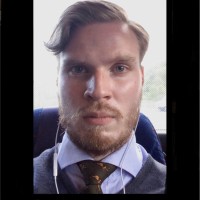
Please note: The brief eulogy below was composed by me, Edmund Schilvold, in 2025, in an attempt to honor the memory of Sindre Steinkopf, my dear friend for roughly four years, i.e. from August 2015 and into 2019, when we lost contact, partly due to difficult circumstances beyond our control. It does not do full justice to the character and the complexity of the person he was, nor to the depth of the connection and recognition I believe both of us felt when our friendship was at its peak, in 2016 and 2017 and 2018, and I intend to write a longer piece on Sindre later. I included this eulogy in the introduction to a paper on the Historicity of Jesus Christ which I published on my profile at Academia.edu that same year, since the nature of the contents of that paper seemed to me congruent with a number of the discussions Sindre and I had, and also with views I know he held, and the intellectual direction in which he was going. The reader should note, however, that a great deal of what Sindre and I shared cannot be described outrightly, since it is simply too ideologically contentious.
Dedication:
This paper is dedicated to the late Rev. Sindre Vegard Malmstein Steinkopf (April 10, 1991–September 16, 2022), a fellow student of philosophy and theology, the most intelligent and talented young man I ever encountered while enrolled at VID Specialized University in Stavanger, Norway, and my dear friend for several years, who committed suicide in the autumn of 2022, only a few months after having reached his goal of becoming an ordained priest.
Mr. Sindre Steinkopf had commenced the strenuous, six years long cand.theol.-program in August 2014, roughly half a year before I began my own theology-studies at VID Stavanger, and he completed his cand.theol.-degree in the summer of 2020. Endowed with an INTJ (“Architect”) mind which was, in several ways, an unusually beautiful and profound one, he could have accomplished a very great deal, if only he had found a way to endure the pain and suffering which comes with feeling all the various facets of existence passionately, understanding more than most, and knowing a little “too much”.
Sindre was a huge fan of Friedrich Nietzsche, who had been one of his foremost heroes for many, many years, and whose distinctive, stylized portrait he would sometimes keep pinned to the wall above his desk, but in spite of this passion for Nietzsche, whom I had never liked very much, he seemed to have a genuine respect for Plato, and a real interest in the person of Christ. The online lectures of the American Platonist Dr. Pierre Grimes, which I introduced him to in 2016, aroused his enthusiasm, too, and he once, in 2017 I think, expressed a sincere desire to visit the United States together with the undersigned, and to meet Dr. Grimes in person.
Sindre was also a lover of beauty in all its forms, a love we certainly shared, and I can still vividly recall how this usually calm and restrained man grew completely ecstatic with joy at the sight of a huge, majestic, thundering, white waterfall (located near the village of Ims) – actually a creek falling down from a cliff, which had been magnified many times beyond its usual size by the exceptionally intense waterfalls of the summer of 2017 – and how he adorned the bare apartment that we eventually rented together and lived in as flatmates on the island of Roaldsøy with atmospheric and evocative 19th-century landscape paintings.
Beyond the works of Nietzsche, he was intrigued by the book title “Christ, the Conqueror”, which appealed to his heroic instinct, and in 2018, he gifted me a fine copy of Pascal’s philosophical Pensées, not knowing that I was already an avid reader of Pascal.
Sindre and I also shared an understanding of and a deep insight into the one-sided and propagandistic nature of much of modern history, and into how this world we are in actually works. We had a small handful of truly unforgettable exchanges, such as the one we would later refer to as “the Conversation below the Tower”, i.e. below the old tower overlooking the harbor in Stavanger, and “the Conversation in the Attic”, meaning in the attic in the old villa in Vistegata 17 that I was living in at the time – exchanges which, to our mutual astonishment, revealed the striking extent to which we had long been pursuing virtually the same trajectories of research, and been reading the same thought-provoking books. In some ways Sindre was ahead of me intellectually, and in terms of comprehension, even though he was significantly younger, and in some ways I was ahead of him, as was only natural.
Not all was “cream and peaches”, however, and in 2018, on a day when he was completely exhausted, he exclaimed, in response to my observation that life is sometimes a struggle, that “I do not know why I am struggling” (Norwegian: “Jeg vet ikke hvorfor jeg kjemper”), meaning that he did not see clearly why he should continue the struggle that his somewhat difficult life constituted. Nevertheless, in 2019 he seemed determined to not only finish his degree, but to use his hard-won intellectual insights to benefit his nation and his people, and to one day make a notable contribution to the academic philosophical debate.
That you could not find the deeper or higher meaning that might have enabled you to soldier on, and that you decided to leave this world at the very time when you had once prophesized that the struggle or fight (Norwegian: kampen) would begin in earnest, is unspeakably tragic. With your departure, Sindre, Norway and Europe lost one of its best and most promising young men, and I have been left to advocate alone for the issues we once dreamed of advocating for together.