Video presentations and documentaries dealing with the decline and fall of various civilizations and societies of the distant past have been garnering surprisingly large numbers of views on platforms like YouTube for some time now. I say surprising because history has often been viewed by the general populace as an eminently boring topic, and because the subject of civilizations which perished thousands of years ago has usually been looked upon as one suitable only for specialists. But then there was the general fascination for Atlantis back in the Victorian Era, exemplified by the success of Ignatius L. Donnelly’s Atlantis: The Antediluvian World, and closer to our own time, before the advent of near-universal Internet access, there was a surge of popular interest in the enigmas of ancient Egypt, to some extent roused by the bestsellers written by pioneering independent researchers like Graham Hancock.
Are the millions of views and thousands of comments some of the «fall of civilizations» videos are getting simply due to a revival of the perennial human fascination for the mysterious and unknown? I suspect that something darker is also at play here; large portions of the population of the so-called West, and perhaps also of some of the Asiatic countries, experience a growing sense of foreboding and doom and ennui; unconscious in many, partly conscious in some; a sense of meaningless and pointlessness and boredom and lack of purpose and approaching death; not the death of the individual, but of everything that once seemed solid and reliable, and was taken for granted; the death of the late modern societies everyone alive today were brought up in, and this darkening of the general mind is indeed congruent with the observable facts:
No «Western» country and very few «Asiatic» countries are seeing birth rates capable of even sustaining its present population, and the concept of Beauty in Art and Architecture appears to have perished almost entirely, and to have been replaced with the gloomy, the disturbing and even the demonic.
In the case of Europe, it seems that the collective unconscious of its peoples, for lack of a better term, was fatally poisoned by the almost incomprehensibly vast amounts of innocent blood shed over the course of the two so-called world wars and their terrible aftermaths, and that this horrific and now largely psychologically repressed history has turned into a kind of collective, unconscious Shadow (in the Jungian sense) which is moving European societies ever closer to the tenebrous fate that awaits all carriers of a Shadow if they fail to make the contents of the Shadow conscious, and to process it and deal with it and come to terms with it and reach a state of reconciliation and integration — in the case of America and Oceania and Asia, the suicidal trajectories are more difficult to account for. It looks as if the form of Modernity the world has developed or fallen pray to over the course of the last few centuries is fundamentally unsustainable — not in a materialistic sense, but in a societal and spiritual sense.

This is unfortunate, for there is much that is good about the modern world, and which most people have never even fully realized the true goodness of, since they have no significant knowledge of pre-modern conditions, not to mention any first-hand experience with such, but here we are. A series of prudent, brave and conscious decisions could easily avert the looming disaster, but my growing suspicion, after years of attempting to impart to other people some of my «INFJ» (?) optimism and idealism and positive spirituality and appreciation for Beauty (efforts going back to when I was in my early 20s), is that many people actually prefer the now increasingly inevitable future demise of the world as we know it. It is not just that Beauty and fertile relationships may be difficult for many to access — it is also that many are unconsciously averse to these aspects of a healthy human existence — in some cases to such an extent that one might wonder of they are in fact demonically possessed, and unable to shake off the yoke of their invisible dark master. I am not joking. Many people still seem perfectly «normal» when it comes to everyday life, but as soon as they face significant challenges or upheavals, they crumble psychologically, or «freak out». (The shocking responses of the majorities to the fear-mongering and the reckless mandates of the «corona»-era are examples of what I have in mind, but one could also take the completely disproportionate reactions of some people to individuals who refuse to fully conform to various social norms and expectations …)
On that cheerful note (ha-ha), I present you with a collection of direct quotes from the ancient Egyptian «Ipuwer papyrus», which seems to be and purports to be an eyewitness account of the near-collapse and demise of the ancient Egyptian civilization, here loosely organized and categorized by subject. As always, I sincerely welcome your thoughts and interpretations.
Civil war and enmity between the Egyptians themselves
“The door [-keepers] say: Let us go and plunder. (…). A man looks upon his son as his enemy; … … …” (1, 1–1, 6.)
“A man strikes his brother (the son) of his mother.” (5, 9–5, 11.)
The inevitability of fate and the fulfillment of ancient prophesies
“Come … … … predestined for you in the time of Horus, in the age of [the Ennead].” (1, 6–1, 9.)
“Forsooth, the face is pale (?) … … … which (?) the ancestors had foretold.” (1, 9–1, 11.)
Tragedy, loss of hope, mass death and mass suicides
“The virtuous man walks in mourning on account of that which has happened in the land.” (1, 6–1, 9.)
“Squalor (?) is throughout the land. There is none whose clothes are white in these times.” (2, 8.)
“Forsooth, many dead men are buried in the river. The stream is a sepulchre, and the place of embalmment has become {the} stream.” (2, 6–7.)
“Forsooth, the river is blood, and (yet) men drink of it. Men shrink from (?) (tasting?) human beings, and thirst after {clean} water.” (2, 10.)
“Forsooth, crocodiles are glutted (?) with what they have captured. Men go to them of their own accord.” (2, 12–2, 13.)
«He who places his brother in the ground is everywhere (?).»
“All is ruin!” (3, 10–3, 13.)
“Forsooth, mirth has perished, and is no longer made. It is groaning that is throughout the land, mingled with lamentations.” (3, 13–3, 14.)
“Forsooth, great and small say: I wish I might die.
Little children say (?): he ought never to have caused me to live (??).” (4, 2–4, 3.)
“Forsooth, the hot-headed (?) man says: If I knew where God is, then would I make offerings unto him.” (5, 3.)
“Forsooth, all animals, their hearts weep. Cattle moan because of the state of the land.” (5, 5.)
“Would that there might be an end of men, no conception, no birth! O that the earth would cease from noise, and tumult be no more!” (5, 12–6, 1.)
“Woe is me because of the misery in this time!” (6, 8.)
Uprisings and invasions
“[The inhabitants?] of the Marshes {the Nile Delta} carry shields.” (1, 1–1, 6.)
“The tribes of the desert (?) have become Egyptians (?) everywhere.” (1, 6–1, 9.)
“Plague {ꞽ(3)dt; possibly an allusion to the “Hyksos” or Amu} is throughout the land. Blood is everywhere.” (2, 5–6.)
“Forsooth, the Desert is throughout the Land. The nomes are laid waste. A foreign tribe from abroad has come to Egypt.” (3, 1.)
“There are no Egyptians anywhere.” (3, 1–3, 2.)
“Forsooth, the builders [of Pyramids (?) have become] field-labourers. Those who were in the divine bark are yoked together (?).” (3, 6–3, 10.)
“Those who were Egyptians (?) have become foreigners (?) … … …” (3, 14–4, 1.)
“Forsooth, the Marshlands in their entirety are not hidden. Lower Egypt can boast of trodden roads. What shall one do?” (4, 5–4, 8.)
“The Asiatics {the Amu; the Semites from the Levant} are skilled in the crafts of the Marshlands.”
“… … … [in the midst] thereof like Asiatics … … …”
“The troops which we recruited for ourselves are become a people of the Bow, and have come to destroy (?).”
Sacking and devastation (c.f. Manetho’s accounts, as preserved by Josephus)
“Forsooth, gates, columns and walls are consumed by fire (…).” (2, 10–11.)
“Forsooth, the ship of the [Southerners] has gone adrift (?). The towns are destroyed. Upper Egypt has become dry [wastes?].” (2, 11.)
“Forsooth, boxes of ebony are broken up. Precious acacia-wood is cleft asunder … … …”
“Forsooth, the children of princes are dashed against the walls.”
“Few are … … … Is it by following the crocodile (?) and cleaving it asunder?
Is it by slaughtering the lion, roasted on the fire?”
“… … … enter into the sepulchres, burn the statues.” (16, 1–17, 2.)
«Biblical»
«A man goes out to plough with his shield.»
«Forsooth, gold and lapis lazuli, silver and malachite, carnelian and bronze, stone of Yebhet and … … … are fastened on the necks of female slaves.»
Crime out of control, release of prisoners
“The wrongdoer is everywhere.” (2, 1–2, 2.)
“Forsooth, the plunderer (?) … … … everywhere.” (2, 2–2, 3.)
“Those who never saw the day go forth unhindered.”
“Men sit over the bushes until the benighted (traveller) comes, in order to plunder his burden. What is upon him is taken away. He is belaboured with blows of the stick, and slain wrongfully.”
The robber is a possessor of riches. (2, 8–2, 9.)
“Forsooth, the laws of the judgement-hall are cast forth. Men walk upon (them) in the public places. Poor men break them up (?) in the streets.”
General confusion, or an unwillingness to face reality
“Every man says: we know not what has happened throughout the land.” (2, 3.)
Revolution and social inversion
Forsooth, the wealthy are in mourning. The poor man is full of joy. Every town says: let us suppress the powerful among us. (2, 7–2, 8.)
“Forsooth, poor men are become owners of good things. He who could make for himself no sandals is (now) the possessor of riches.”
«The robber is a possessor of riches. (The rich man?) is [become?] a plunderer.»
«Noble ladies suffer (??) like slave-girls.»
«Forsooth all female slaves are free with their tongues. When their mistress speaks, it is irksome to the servants.»
«Forsooth, [Right] is throughout the land in this, its name. What men do, in appealing to it, is Wrong.»
«Serfs become lords of serfs (?).»
«Forsooth, the poor man has come to the estate (?) of the divine Ennead.»
«Behold, a few lawless men have ventured to despoil the land of the kingship.»
«Behold, men have ventured to rebel against the Uraeus, the … … … of Re. which pacifies the two lands.»
«He who could make for himself no sarcophagus is (now) possessor of a tomb.»
«Behold, this has happened (to?) men: he who could not build himself a cell is now possessor of walls.»
«He who never slept upon walls (?) is now the possessor of a bed.»
«Behold, the possessor of wealth (now) passes the night thirsting. He who begged for himself his dregs is (now) the possessor of bowls full to overflowing (?).»
«Behold, the possessors of robes are (now) in rags. He who never wove for himself is (now) the possessor of fine linen.»
«Behold, the poor of the land have become rich, and the possessor of property has become one who has nothing.»
«Behold, noble ladies, great ladies, mistresses of goodly things give their children for beds (?).»
«Behold, the children of courtiers are … … … {become the servants of courtiers?} [Rich men hand over the] calves (??) of their cows (?) to plunderers.»
Moral decay, timidity, lack of courage
“Forsooth, men are few. He who places his brother in the ground is everywhere (?). When the officiants (?) have spoken, he [flees?] without delay.” (2, 13–2, 14.)
“Behold, a man is slain beside his brother. He … … … to save his (own) limbs.”
Somewhat perplexing and mysterious statements
«People shall surely (?) say: cursed be (?) the secret place.»
«Laid bare is the secret place that was (such formerly??).»
«Forsooth, magical spells are divulged. Sm-incantations (?) and shn-incantations (?) are frustrated (?) because they are remembered by men.»
«Behold, the fire has mounted up on high. Its burning goes forth against the enemies of the land.»
«Behold, the secret of the land, whose limits were unknown, is divulged. The Residence is overturned in a minute.»
«Behold, the Serpent is taken from its hole. The secrets of the kings of Upper and Lower Egypt are divulged.»
«Behold, he who was buried as a hawk is … … … What the pyramid concealed is become empty.»
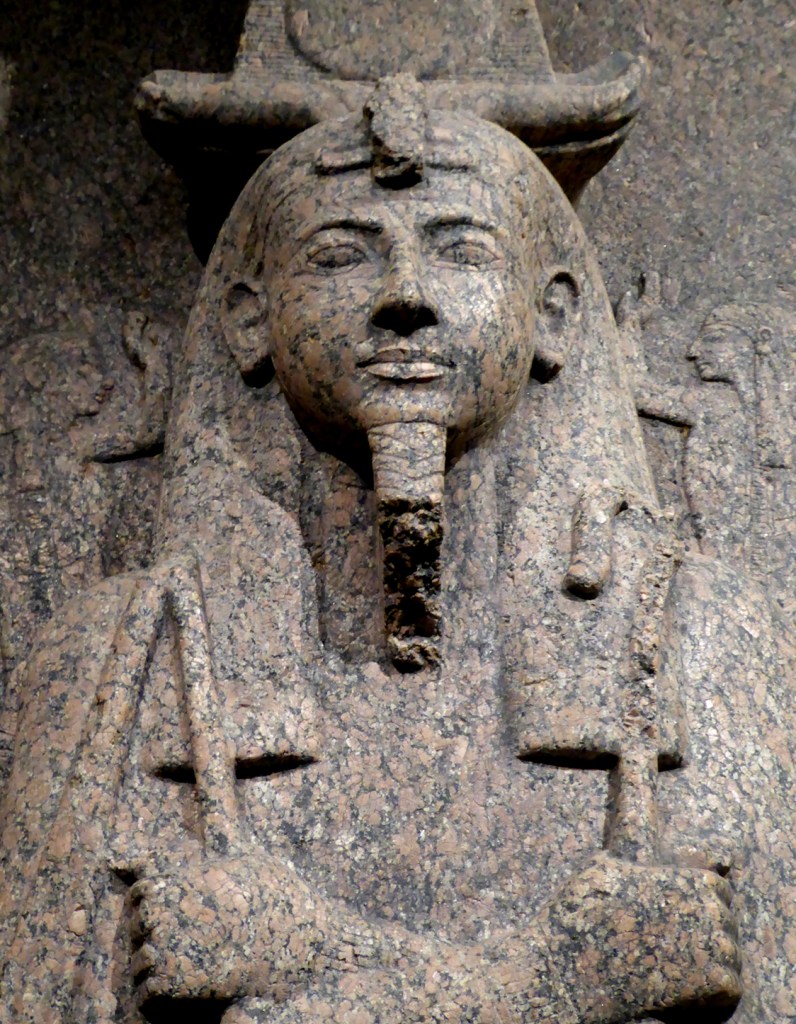
Ramesses III (on a personal note, I will never forget the first time I saw a black and
white photograph of this lid, as it sent chills down my spine. The artistry and
craftsmanship here displayed is nothing short of stunning.) Fitzwilliam Museum.
Compare the rather enigmatic mention of a «fire» mounting up on high above to the equally curious references in the Medinet Habu texts of King Ramesses III comemmorating the second Egyptian victory over the «Sea Peoples»:
«They were coming forward toward Egypt, while the flame was prepared before them. Their confederation was the Philistines, Tjeker, Shekelesh, Denye(n), and Weshesh, lands united.»
«Those who reached my frontier, their seed is not, their heart and their soul are finished forever and ever. Those who came forward together on the sea, the full flame was in front of them at the river-mouths, while a stockade of lances surrounded them on the shore.»
«I have made the lands turn back from (even) mentioning Egypt; for when they pronounce my name in their land, then they are burned up.»
If you enjoyed this post on Lost Civilizations and the «Ipuwer Papyrus» (the hieratic Egyptian text recorded on the recto side of Papyrus Leiden I 344), I would strongly encourage you to download and read my academic essay and e-book on the topic of the misleadingly named «Sea Peoples», called «The War between the Theban Egyptians and the ‘Hyksos’: The ‘Sea Peoples’ Confederation of Tribes Strikes Back: A Study of Inscriptions from the reign of Amenhotep the Great to that of Ramesses the Third», which you may peruse and download for free from my profile page at Academia.edu.

