On Extroversion and Introversion as fundamental tendencies shaping human history and the underlying reason for the perennial conflicts between Rationalism and Empiricism, Nominalism and Realism, Gnosis and Scripture, etc. (Excerpts from Carl Jung’s highly insightful work on Psychological Types, Part One):
The following quotes are from the initial part of this extensive work, the part where Jung is engaged in a broad survey of the basic psychological categories of Introversion and Extroversion, and of how these affected ancient and medieval thought in Europe, and, more particularly, the conflicts more or less familiar to all students of history and religion and philosophy, namely the debates between the Platonists and the more worldly and nominalistic and empirical schools of thought, and between the Christians and other believers inclined towards Gnosticism or Inner Knowledge and those preferring the external authority of supposedly holy Scripture and the fixed principles of Dogmas and of Faith.
As I hinted at in an earlier post, I think Jung hits the nail on its head in his analysis here, when he explains these and other divisions as rooted in fundamental psychological differences between individuals, and I also think I have been able to observe the results of these different tendencies in my own life, as in my encounters with and conflicts with certain unforgettable people, for example — even though I did not begin to develop a deeper comprehension of what was actually going on until a few years ago.
The lateness of this realization was unfortunate, for an earlier understanding of the given fact of human psychological types could probably have prevented a great deal of confusion and agony, made it easier to choose a suitable personal path and a proper individual purpose at a young age, and made the search for that elusive Love less thorny, to mention only a few examples, and I have even arrived at the view that the phenomenon of Types, which was anticipated by Plato almost 2,500 years ago, when he set forth his great allegory of the City and its different Governments, needs to be taught to children in the schools, so that they may be equipped with the necessary tools to understand and relate to both their peers and their own inner selves in a compassionate and constructive way, and to lessen the Type conflicts they will sooner or later encounter and engender — for, as Jung shows, both the Introverts and the Extroverts tend to assume that their own psychology is also, more or less, that of others, and vice versa, that their own worldview, fundamentally colored by their own inner psychology, is the only correct one, or the best one, and to unwittingly project their own tendencies and preferences onto the external world and other human beings, instead of seeking mediation and compromises, and this attitude of imposition, which does not usually see itself for what it is, leads to endless series of faulty assumptions, hostile, fruitless debates and even violence and war, while no genuine progress towards a higher state of being and a synthesis is ever actually made.
Technological innovations come and go, but the human mind and its splitting into Types is largely the same as it was two thousand years ago, although Jung does postulate a certain pervasive difference in the way of relating to the world between the ancient and the modern human being.
(Incidentally, it is a sad fact that while the educational systems in the Nordic and the Scandinavian countries are often extolled by foreign onlookers, such as those in America, as models of learning and positive conditioning, bullying, harassment and maltreatment remain huge problems in both primary and high schools, and are, according to some stats, more pervasive now than ever, demonstrating the need for a radically different approach to education than the one various reforms have been leading us towards since the post-war-era.)
Quotes from Psychological Types:
Tertullian is, so to speak, a classic representative of the introverted thinker. His considerable, extremely well-developed intellect is flanked by unmistakable sensuality. The process of psychological development, which we call the Christian process, led him to sacrifice, to the cutting off of his most valuable organ, which mythical idea is again contained in the great and exemplary symbol of the sacrifice of the Son of God. His most valuable organ was precisely the intellect and the clear knowledge it provided. The sacrificium intellectus made it impossible for him to develop purely intellectually, forcing him to recognize the irrational dynamism of his soul as the foundation of his being. The intellectual aspect of gnosis, its specific intellectual expression of the dynamic phenomena of the soul’s ground, must necessarily have been hateful to him, for it was precisely the path he had to abandon in order to recognize the principle of feeling.
In Origen we get to know the absolute opposite of Tertullian. Origen was born in Alexandria around 185. His father was a Christian martyr. He himself grew up in that very peculiar intellectual atmosphere in which the thoughts of Orient and Occident mingled. With great curiosity, he acquired everything worth knowing, and so he absorbed everything that the rich Alexandrian world of thought of that time offered, Christian, Jewish, Hellenistic, Egyptian. He excelled as a teacher at a catechetical school.
The pagan philosopher Porphyrius, a pupil of Plotinus, said of him: «His outward life was that of a Christian and contrary to the law; but in his view of things and of the deity he Hellenized and subordinated the ideas of the Greeks to foreign myths.» His self-castration, whose motives can be guessed at but are historically unknown, took place before 211. He was personally very influential and had a winning speech. He was always surrounded by pupils and a whole host of stenographers who took down the precious words that fell from the mouth of his revered teacher. He was extraordinarily prolific as a writer and developed a great teaching activity. In Antioch he even lectured on theology to the empress mother Mammaea. He was the head of a school in Caesarea. His teaching activities were often interrupted by extensive travels. He was extraordinarily erudite and had an astonishing ability to investigate things carefully. He tracked down old Bible manuscripts and made a special contribution to textual criticism. «He was a great scholar, indeed, the only true scholar that the ancient church possessed,» says Harnack. Origen, in complete contrast to Tertullian, did not close himself off to the influence of Gnosticism; on the contrary, he even introduced it in a milder form into the schooss of the Church; at least that is what he strove for. Indeed, he was, so to speak, a Christian Gnostic himself, according to his thinking and his basic views.
Jung, Carl. Psychological Types (pp. 20-21). Minerva. Kindle Edition.
We see here how in the Christian process the original type was actually [p. 30] reversed: Tertullian, the sharp thinker, becomes a man of feeling; Origen becomes a scholar and loses himself to the intellectual. It is of course easy to turn the matter around logically and say that Tertullian has always been the emotional person and Origen the intellectual. Apart from the fact that this does not eliminate the typical difference, which still exists, the reverse view does not explain why it is that Tertullian saw his most dangerous enemy in intellectuality and Origen in sexuality.
One could say that they were both mistaken, and one could use the fatal outcome of both their lives as an argument. In this case, one would have to assume that both of them had sacrificed what was less important to them, in other words, to a certain extent they had engaged in horse-trading with fate. This is also a view whose principle is of recognizable validity. …
I am of the opinion, however, that despite the unmistakable relief that ordinary people feel when something big is torn down, the devaluing explanation is not the right one in all circumstances, even if it sounds very «biological». As far as we know these two great men in the realm of the spirit personally, however, we must say that their whole manner is so serious that their Christian reversal was neither deception nor fraud, but reality and truthfulness.
We do not lose ourselves on a byway if we take this opportunity to visualize what the breaking of the natural drive, as which the Christian (sacrificial) process appears, means psycho [p. 31] logically: it follows from the above that the reversal also means the transition to a different attitude. This also makes it clear where the driving motive for conversion comes from, and to what extent Tertullian is right to understand the soul as «naturaliter christiana»: The natural direction of instinct, like everything in nature, follows the principle of the smallest measure of force. Now one person has a little more disposition here, the other there. Or the adaptation to the first environment of childhood requires a little more restraint and reflection or a little more empathy, depending on the nature of the parents and the circumstances. As a result, a certain preference is automatically formed, which results in different types. Inasmuch as every person, as a relatively stable being, possesses all the basic psychological functions, it would also be a psychological necessity with regard to perfect adaptation that the person also uses them equally.
For there must be a reason why there are different ways of psychological adaptation: obviously one alone is not enough, for example because the object seems to be only partially grasped as something that is merely thought or merely felt. A one-sided («typical») attitude leaves a deficit in the psychological capacity to adapt, which accumulates over the course of a lifetime, leading sooner or later to the development of an adjustment disorder that forces the subject to compensate.
However, compensation can only be achieved by cutting off (sacrificing) the previous one-sided attitude. This results in a temporary build-up of energy and an overflow into channels that were previously consciously unused but unconsciously available. The deficit of adaptation, which is the causa efficiens of the process of reversal, becomes subjectively noticeable as a feeling of indefinite [p. 32] dissatisfaction.
Such an atmosphere prevailed at the turn of our era. An extraordinary and astonishing need for redemption overcame mankind and brought about that unheard-of flourishing of all possible and impossible cults in ancient Rome. There was also no shortage of proponents of the living-out theory, who operated on the basis of the science of the time instead of «biology». Nor could there be enough speculation as to why people were doing so badly; only the causalism of that time was somewhat less limited than that of our science; people did not just go back to childhood, but to cosmogony and devised numerous systems that proved what had happened in prehistoric times, which then resulted in unpleasant consequences for mankind.
The sacrifice made by Tertullian and Origen is drastic, too drastic for our taste, but it corresponded to the spirit of the time, which was thoroughly concretistic. In this spirit, Gnosticism took its visions to be absolutely real, or at least directly related to something real, and Tertullian took the fact of his feeling to be objectively valid. Gnosticism projected the subjective inner perception of the process of attitudinal change as a cosmogonic system and believed in the reality of its psychological figures.
Jung, Carl. Psychological Types (pp. 24-26). Minerva. Kindle Edition.
And beneath this layer lies the great psychological schism.
On the one hand, the assertion that the main value and the main meaning lies with the sensually perceptible, whose subject, if not always human-personal, is at least always a projected human feeling; on the other hand, the assertion that the main value and the main meaning lies with the sensually perceptible, whose subject, if not always human-personal, is always a projected human feeling.
On the other hand, the assertion that the main value lies in the abstract and extra-human, whose subject is the function, that is, the objective natural process, which proceeds in impersonal regularity, beyond human sensation, indeed even as its basis.
Jung, Carl. Psychological Types (pp. 28-29). Minerva. Kindle Edition.
Constructive judgment, which, in contrast to inherence, focuses on the conformity of things, has generated general ideas that are among the highest cultural assets. Even if these ideas belong to the dead, we are still connected to them by threads that, as Gomperz says, have gained a strength that can hardly be broken.
He continues: «Like the disembodied corpse, in this way the unsouled can also acquire a claim to protection, honor and even self-sacrificing devotion; think of portraits, graves, the soldier’s flag. But if I do violence to myself and successfully try to tear up this web, I fall prey to brutalization, I suffer a severe loss of all the feelings that clothe the hard rocky ground of naked reality as if with a rich blanket of blooming life. All refinement, all adornment and grace of life, all ennoblement of animal instincts, as well as all enjoyment of art and artistry – precisely all that which the Cynics endeavored to eradicate without scruple or compassion – rests on the upholding of this overgrowth, on the appreciation of all that one might call acquired values. Certainly – and this may be readily conceded to them and their not too rare modern successors – there is a limit beyond which we may not follow the rule of the principle of association without being accused of folly, indeed of superstition, which has grown entirely out of the unrestrained rule of that principle.»
Jung, Carl. Psychological Types (pp. 44-45). Minerva. Kindle Edition.
Aristotle’s moderate realist view, which can be described as «universalia in re», stands between the two views, namely that form (εἶδος) and substance exist together. The Aristotelian point of view is a concretist attempt at mediation, which corresponds completely to the nature of Aristotle. In contrast to the transcendentalism of his teacher Plato, whose school then lapsed into Pythagorean mysticism, Aristotle was entirely a man of reality, his ancient reality, it must be said, which contained much that later times took out and added to the inventory of the human mind. His solution corresponds to the concretism of ancient common sense.
Jung, Carl. Psychological Types (pp. 48-49). Minerva. Kindle Edition.
Rather, it is a matter of profound psychological differences that need to be acknowledged and held firmly. The assumption that there is only one psychology or only one basic psychological principle is an unbearable tyranny of the pseudo-scientific prejudice of the normal person. One always speaks of man and his «psychology», which is always reduced to «nothing but». Similarly, we always speak of reality as if there were only one. Reality is that which works in a human soul and not that which is assumed to work by certain people and generalized in a biased way. No matter how scientifically this is done, it should not be forgotten that science is not the «summa» of life, and that it is even only one of the psychological attitudes, even only one form of human thinking.
Jung, Carl. Psychological Types (p. 51). Minerva. Kindle Edition.
In the language of analytical psychology, the concept of God coincides with that complex of ideas which, according to the previous definition, unites the highest sum of libido (psychic energy). Accordingly, the factual concept of God of the anima would be quite different in different people, which also corresponds to experience. God is not even a fixed being in the idea, much less in reality. For the highest active value of a human soul is, as is well known, localized very differently. There are those ὧν ὁ θεὸς ἡ κοιλία (whose god is the belly, Phil. 3, 19), money, science, power, sexuality, etc. Depending on the localization of the highest good, the whole psychology of the individual shifts, at least in the main traits, so that a psychological «theory» based exclusively on some basic instinct, such as lust for power or sexuality, applied to a person of a different orientation, can only ever adequately explain the traits of secondary importance.
Jung, Carl. Psychological Types (p. 57). Minerva. Kindle Edition.
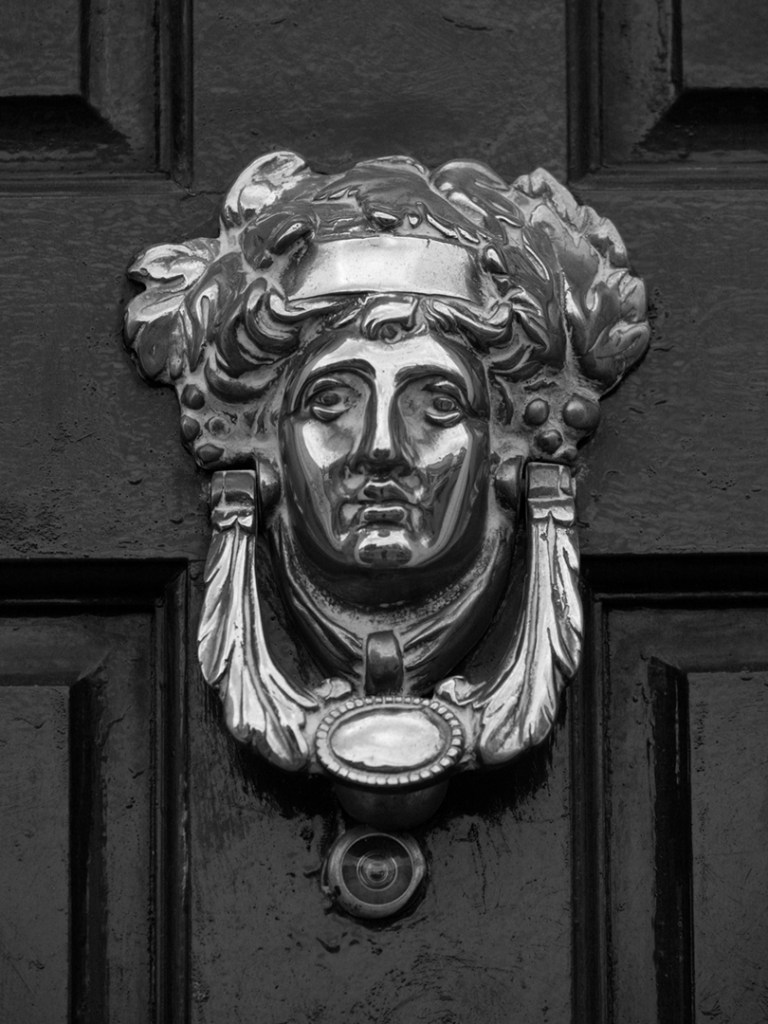
Photo: Ornate doorknob in the Georgian part of Dublin, Ireland. Edmund Schilvold, 2010.
This post was originally published on my Academia.edu profile page in July 2025: https://www.academia.edu/community/LxjoNZ
It received 178 views, five likes and one comment.

Photo: View of the sublime Slieve League cliffs in county Donegal, Ireland, one stormy evening in May. Edmund Schilvold, 2007.

