Plato’s famous crucified Just Man – the real inspiration underlying the Christian crucifixion narrative (as we now have it), or a supernatural Socratic–Platonic prophesy predicting the fate of Jesus, the Righteous Notzri/Nazarene? (Easter; Resurrection Day)
Below is the famous passage, in Allan Bloom’s literal translation (digitized by the undersigned), as well as the fascinating context:
Excerpts from Book II of Plato’s “Republic”/Politeia
[358e]
[Glaukon:] “Now listen to what I said I was going to tell first—what justice is and where it came from.
They say that doing injustice is naturally good, and suffering injustice bad, but that the bad in suffering injustice far exceeds the good in doing it; so that, when they do injustice to one another and suffer it and taste of both, it seems profitable – to those who are not able to escape the one and choose the other – to set down a compact among themselves neither to do injustice nor to suffer it.
[359a]
And from there they began to set down their own laws and compacts and to name what the law commands lawful and just.
And this, then, is the genesis and being of justice; it is a mean between what is best –doing injustice without paying the penalty – and what is worst – suffering injustice without being able to avenge oneself.
The just is in the middle between these two, cared for not because it is good but because it is honored due to a want of vigor in doing injustice.
The man who is able to do it and is truly a man would never set down a compact with anyone not to do injustice and not to suffer it. He’d be mad.
[This is exactly what happened in France in late 1700s, in the wake of the first Revolution there, and, later, over the course of the initial decades of the 20th century, in one Communist country after another – the Soviet Union, Hungary, Spain, etc. – the Rule of Law was, in effect, abolished, and replaced with Tyranny and a Reign of Terror, exercised by a ruthless minority consisting of criminals and clinical psychopaths who, not believing in an Afterlife of Just Rewards and Punishments, thought they could do whatever they wanted, including the carrying out of the most heinous acts of violence, torture, sadism and desecration, without ever having to pay the just penalty. – E.S.]
[359b]
Now the nature of justice is this and of this sort, and it naturally grows out of these sorts of things.
So the argument goes.
[Here comes the Legend of the Ring of Gyges, one of the foremost sources of inspiration underlying John Ronald Reuel Tolkien’s Lord of the Rings-narrative, which is much more “Platonic” than most people realize.
Also note that the Jesus of the gospel narratives is sometimes portrayed as suddenly vanishing from sight when having gotten himself into a dangerous situation and being threatened with violence. Contrary to the Gyges of legend, however, neither the Jesus of the gospels or the “Yeshu ha-Notzri” of the uncensored Talmud ever abuses his miraculous or theurgical powers to injure others – although the Talmud does accuse him of non-violent “sorcery”, and of somehow “leading Israel astray”.]
“That even those who practice it do so unwillingly, from an incapacity to do injustice, we would best perceive if we should in thought do something like this:
give each, the just man and the unjust, license to do whatever he wants, while we follow and watch where his desire will lead each.
[359c]
We would catch the just man red-handed going the same way as the unjust man out of a desire to get the better; this is what any nature naturally pursues as good, while it is law which by force perverts it to honor equality.
The license of which I speak would best be realized if they should come into possession of the sort of power that it is said the ancestor of Gyges, the Lydian, once got.
They say he was a shepherd toiling in the service of the man who was then ruling Lydia.
[359c]
There came to pass a great thunderstorm and an earthquake; the earth cracked and a chasm opened at the place where he was pasturing. He saw it, wondered at it, and went down. He saw, along with other quite wonderful things about which they tell tales, a hollow bronze horse. It had windows; peeping in, he saw there was a corpse inside that looked larger than human size. It had nothing on except a gold ring on its hand; he slipped it off and went out.
[359e]
When there was the usual gathering of the shepherds to make the monthly report to the king about the flocks, he too came, wearing the ring. Now, while he was sitting with the others, he chanced to turn the collet of the ring to himself, toward the inside of his hand; when he did this, he became invisible to those sitting by him, and they discussed him as though he were away.
[360a]
He wondered at this, and, fingering the ring again, he twisted the collet toward the outside; when he had twisted it, he became visible. Thinking this over, he tested whether the ring had this power, and that was exactly his result: when he turned the collet inward, he became invisible, when outward, visible. Aware of this, he immediately contrived to be one of the messengers to the king.
When he arrived, he committed adultery with the king’s wife and, along with her, set upon the king and killed him. And so he took over the rule.
Now if there were two such rings, and the just man would put one on, and the unjust man the other, no one, as it would seem, would be so adamant as to stick by justice and bring himself to keep away from what belongs to others and not lay hold of it, although he had license to take what he wanted from the market without fear, and to go into houses and have intercourse with whomever he wanted, and to slay or release from bonds whomever he wanted, and to do other things as an equal to a god among humans [“god” here being a reference to the lesser gods of popular imagination, originally derived from the woefully misinterpreted and misunderstood allegorical theogonies and mythologies once created by ancients like Orpheus in order to record and encode and preserve the sophisticated knowledge of topics like the processes of Nature and of the Cosmos, and astronomical and astrological cycles, in a symbolical form. – E.S.].
And in so doing, one would act no differently from the other, but both would go the same way.
And yet, someone could say that this is a great proof that no one is willingly just but only when compelled to be so.
Men do not take it to be a good for them in private, since wherever each supposes he can do injustice, he does it.
Indeed, all men suppose injustice is far more to their private profit than justice.
[360d]
And what they suppose is true, as the man who makes this kind of an argument will say, since if a man were to get hold of such license and were never willing to do any injustice and didn’t lay his hands on what belongs to others, he would seem most wretched to those who were aware of it, and most foolish too, although they would
praise him to each others’ faces, deceiving each other for fear of suffering injustice.
So much for that.
As to the judgment itself about the life of these two of whom we are speaking, we’ll be able to make it correctly if we set the most just man and the most unjust in opposition; if we do not, we won’t be able to do so.
What, then, is this opposition?
It is as follows: we shall take away nothing from the injustice of the unjust man nor from the justice of the just man, but we shall take each as perfect in his own pursuit.
So, first, let the unjust man act like the clever craftsmen. [“Clever craftsmen” could be an allusion the demiurgical powers in charge of the physical-material-manifestational universe; the Realm of Becoming; of Generation or Genesis.]
[361a]
An outstanding pilot or doctor is aware of the difference between what is impossible in his art and what is possible, and he attempts the one, and lets the other go; and if, after all, he should still trip up in any way, he is competent to set himself aright.
Similarly, let the unjust man also attempt unjust deeds correctly, and get away with them, if he is going to be extremely unjust. The man who is caught must be considered a poor chap.
For the extreme of injustice is to seem to be just when one is not.
[This is precisely how “the Scribes and Pharisees” of the canonical Christians gospels are portrayed by both the narrators and by the Jesus of those gospels himself – they are always attempting to seem perfectly just, whereas the reality is that they are extremely unjust. The New Testament portrayals of these ancient Israelite intellectuals and leaders are perhaps caricatures, however. – E.S.]
So the perfectly unjust man must be given the most perfect injustice, and nothing must be taken away; he must be allowed to do the greatest injustices while having provided himself with the greatest reputation for justice.
And if, after all, he should trip up in anything, he has the power to set himself aright; if any of his unjust deeds should come to light, he is capable both of speaking persuasively and of using force, to the extent that force is needed, since he is courageous and strong and since he has provided for friends and money.
[Here the intelligent reader should once again be reminded of the deplorable and soul-crushing state of affairs usually prevailing in many of the Communist states of the 20th century, where the truth was continuously suppressed, with an evil sophistication most people here in the West cannot even begin to imagine, where the act of lying was turned into a perverse form of art, and a terrible weapon, and where all dissent which did not benefit the tyrants in charge in some way was either violently and ruthlessly crushed or subverted and annihilated by way of clever infiltration. Yakov Sverdlov, one of Lenin’s foremost associates, and guilty of ordering the execution of the entire Russian royal family, including all the children, and of not even granting them dignified burials, viewed and portrayed himself as a hero, and the town where the murders were perpetrated was later renamed Sverdlovsk, “in honor of” the leader of the murderers. In the fakery that was official Soviet history, moreover, the whole Romanov Dynasty was portrayed as a dynasty of barbarians and oppressors, when the truth of the matter was that they had first liberated both Russia and what is now Ukraine from the vestiges of the old tyranny of the Mongols and the barbaric slave trade of the Tartars of Crimea, that they had then liberated much of Eastern Europe and the Caucasus from the tyranny of the Islamic Ottoman Empire, and, finally, that they had liberated the serfs of their own society and made the Russia of the late 1800s and early 1900s one of the most successful and sophisticated Christian empires on the globe. – E.S.]
[361b]
Now, let us set him down as such, and put beside him in the argument the just man in his turn, a man simple and noble, who, according to Aeschylus, does not wish to seem, but rather to be, good.
The seeming must be taken away. For if he should seem just, there would be honors and gifts for him for seeming to be such. Then it wouldn’t be plain whether he is such for the sake of the just or for the sake of the gifts and honors.
So he must be stripped of everything except justice, and his situation must be made the opposite of the first man’s. Doing no injustice, let him have the greatest reputation for injustice, so that his justice may be put to the test to see if it is softened by bad reputation and its consequences.
Let him go unchanged till death, seeming throughout life to be unjust although he is just, so that when each has come to the extreme – the one of justice, the other of injustice – they can be judged as to which of the two is happier.
[Socrates:] “My, my,” I said, “my dear Glaucon, how vigorously you polish up each of the two men – just like a statue – for their judgment.”
“As much as I can,” he said. “With two such men it’s no longer hard, I suppose, to complete the speech by a description of the kind of life that awaits each.
[361e]
It must be told, then. And if it’s somewhat rustically told, don’t suppose that it is I who speak, Socrates, but rather those who praise injustice ahead of justice.
They’ll say that the just man who has such a disposition will be whipped; he’ll be racked; he’ll be bound; he’ll have both his eyes burned out;
[362a]
and, at the end, when he has undergone every sort of evil, he’ll be crucified [ἀνασχινδυλευθήσεται] and know that one shouldn’t wish to be, but to seem to be, just.
[The ancient Greek term here translated by Allan Bloom as “will be crucified” is “ἀνασχινδυλευθήσεται”, a future form of the verb ἀνασκολοπίζω; “I impale” or “I fix on a pole/stake”. See https://lsj.gr/wiki/%E1%BC%80%CE%BD%CE%B1%CF%83%CE%BA%CE%BF%CE%BB%CE%BF%CF%80%CE%AF%CE%B6%CF%89]
After all, Aeschylus’ saying applies far more correctly to the unjust man. For really, they will say, it is the unjust man, because he pursues a thing dependent on truth and does not live in the light of opinion, who does not wish to seem unjust but to be unjust,
‘Reaping a deep furrow in his mind
From which trusty plans bear fruit.’
First, he rules in the city because he seems to be just. Then he takes in marriage from whatever station he wants and gives in marriage to whomever he wants; he contracts and has partnerships with whomever he wants, and, besides benefiting himself in all this, he gains because he has no qualms about doing injustice.
So then, when he enters contests, both private and public, he wins and gets the better of his enemies. In getting the better, he is wealthy and does good to friends and harm to enemies.
To the gods he makes sacrifices and sets up votive offerings, adequate and magnificent, and cares for the gods and those human beings he wants to care for far better than the just man.
[Compare this to the public displays of charity and worship and the deplorable hypocrisy so vehemently criticized by Jesus in Matthew, chapter 6:
“Take care that you do not your [acts of] righteousness in front of others in order to be seen by them: otherwise you have no reward with your Father (Pater) who is in the Heavens.
When therefore you do acts of compassion, do not sound not a trumpet before you, as the hypocrites do in the synagogues (assemblies) and in the streets, that they may be glorified by the people.
Verily I say unto you, they receive their [proper, bitter] wages.
But when you do acts of compassion, let not your left hand know what your right hand is doing, and your compassion may remain secret – and your Father (Pater), the One seeing in secret (in the dark), will reward you.
And when you pray, you shall not be like the hypocrites, for they love to pray standing in the synagogues (assemblies) and on the corners of the streets, so that they may be seen by the people.
Verily I say unto you, they receive their [proper, bitter] wages.
You, however, when you pray, enter into your secret (inner) chamber (your treasury), and, having shut your door, pray to your Father (Pater), the One (residing) in (the) secret, and your Father, the One seeing in secret (in the dark), will reward you.”
(If I were an ordinary Christian, I would ask myself: Is this and other descriptions of Jesus’ “the Father in the Heavens” compatible with the YHWH of the Old Testament? Moreover, do these new commandments sound like en endorsement of Pharisaical or Rabbinical Judaism? Finally, have any of the mainstream Christian churches ever followed these commandments? Do not the common liturgies and masses encourage Christians do to precisely that which Jesus is discouraging his followers from doing? Is it not perfectly clear, if these sayings are authentic, that Jesus advocated for an individual, inner, spiritual type of religio-philosophical system, as opposed to the communal, outer, worldly type?)]
So, in all likelihood, it is also more appropriate for him to be dearer to the gods than is the just man. Thus, they say, Socrates, with gods and with humans, a better life is provided for the unjust man than for the just man.”
When Glaucon had said this, I had it in mind to say something to it, but his brother Adeimantus said in his turn, “You surely don’t believe, Socrates, that the argument has been adequately stated?”
“Why not?” I said.
“What most needed to be said has not been said,” he said. “Then,” I said, “as the saying goes, ‘let a man stand by his brother.’ So, you too, if he leaves out anything, come to his defense. And yet, what he said was already enough to bring me to my knees and make it impossible to help out justice.”
And he said, “Nonsense. But still hear this too. We must also go through the arguments opposed to those of which he spoke, those that praise justice and blame injustice, so that what Glaucon in my opinion wants will be clearer.
No doubt, fathers say to their sons and exhort them, as do all those who have care of anyone, that one must be just. However, they don’t praise justice by itself but the good reputations that come from it;
they exhort their charges to be just so that, as a result of the opinion, ruling offices and marriages will come to the one who seems to be just, and all the other things that Glaucon a moment ago attributed to the just man as a result of his having a good reputation. And these men tell even more of the things resulting from the opinions. For by throwing in good reputation with the gods, they can tell of an inexhaustible store of goods that they say gods give to the holy. And in this way they join both the noble Hesiod and Homer.
(…)
“My dear Socrates,” he said, “with all these things being said – of this sort and in this quantity – about virtue and vice and how human beings and gods honor them, what do we suppose they do to the souls of the young men who hear them?
I mean those who have good natures and have the capacity, as it were, to fly to all the things that are said and gather from them what sort of man one should be and what way one must follow to go through life best. In all likelihood he would say to himself, after Pindar, will I ‘with justice or with crooked deceits scale the higher wall’ where I can fortify myself all around and live out my life?
For the things said indicate that there is no advantage in my being just, if I don’t also seem to be, while the labors and penalties involved are evident. But if I’m unjust, but have provided myself with a reputation for justice, a divine life is promised.
Therefore, since as the wise make plain to me, ‘the seeming overpowers even the truth’, and is the master of happiness, one must surely turn wholly to it.
As facade and exterior I must draw a shadow painting of virtue all around me, while behind it I must trail the wily and subtle fox of the most wise Archilochus.
‘But,’ says someone, ‘it’s not always easy to do bad and get away with it unnoticed.’
‘Nothing great is easy,’ we’ll say. ‘But at all events, if we are going to be happy we must go where the tracks of the arguments lead.
For, as to getting away with it, we’ll organize secret societies and clubs; and there are teachers of persuasion who offer the wisdom of the public assembly and the court.
On this basis, in some things we’ll persuade and in others use force; thus we’ll get the better and not pay the penalty.’
‘But it surely isn’t possible to get away from the gods or overpower them.’ ‘But, if there are no gods, or if they have no care for human things, why should we care at all about getting away? And if there are gods and they care, we know of them or have heard of them from nowhere else than the laws, and the poets who have given genealogies; and these are the very sources of our being told that they are such as to be persuaded and perverted by sacrifices, soothing vows, and votive offerings.
Either both things must be believed or neither. If they are to be believed, injustice must be done and sacrifice offered from the unjust acquisitions.
For if we are just, we won’t be punished by the gods. That is all. And we’ll refuse the gains of injustice.
But if we are unjust, we shall gain and get off unpunished as well, by persuading the gods with prayers when we transgress and make mistakes.’
‘But in Hades we’ll pay the penalty for our injustices here, either we ourselves or our children’s children.’ ‘But, my dear,’ will say the man who calculates, ‘the initiations and the delivering gods have great power, as say the greatest cities and those children of gods who have become poets and spokesmen of the gods and reveal that this is the case.’
“Then, by what further argument could we choose justice before the greatest injustice? For, if we possess it with a counterfeited seemly exterior, we’ll fare as we are minded with gods and human beings both while we are living and when we are dead, so goes the speech of both the many and the eminent.
After all that has been said, by what device, Socrates, will a man who has some power – of soul, money, body or family – be made willing to honor justice and not laugh when he hears it praised?
(…)
I listened, and although I had always been full of wonder at the nature of Glaucon and Adeimantus, at this time I was particularly delighted and said, “That wasn’t a bad beginning, you children of that man, that Glaucon’s lover made to his poem about your distinguishing yourselves in the battle at Megara: Sons of Ariston, divine offspring of a famous man.
That, my friends, in my opinion is good. For something quite divine must certainly have happened to you, if you are remaining unpersuaded that injustice is better than justice when you are able to speak that way on its behalf.
Now you truly don’t seem to me to be being persuaded. I infer it from the rest of your character, since, on the basis of the arguments themselves, I would distrust you. And the more I trust you, the more I’m at a loss as to what I should do.
On the one hand, I can’t help out. For in my opinion I’m not capable of it; my proof is that when I thought I showed in what I said to Thrasymachus that justice is better than injustice, you didn’t accept it from me. On the other hand, I can’t not help out. For I’m afraid it might be impious to be here when justice is being spoken badly of and give up and not bring help while I am still breathing and able to make a sound.
So the best thing is to succour her as I am able.”
Glaucon and the others begged me in every way to help out and not to give up the argument, but rather to seek out what each is and the truth about the benefit of both. So I spoke my opinion.
“It looks to me as though the investigation we are undertaking is no ordinary thing, but one for a man who sees sharply. Since we’re not clever men,” I said, “in my opinion we should make this kind of investigation of it:
if someone had, for example, ordered men who don’t see very sharply to read little letters from afar and then someone had the thought that the same letters are somewhere else also, but bigger and in a bigger place, I suppose it would look like a godsend to be able to consider the littler ones after having read these first, if, of course, they do happen to be the same.”
“Most certainly,” said Adeimantus. “But, Socrates, what do you notice in the investigation of the just that’s like this?”
“I’ll tell you,” I said. “There is, we say, justice of one man; and there is, surely, justice of a whole city too?”
“Certainly,” he said.
“Is a city bigger than one man?”
“Yes, it is bigger;” he said.
“So then, perhaps there would be more justice in the bigger and it would be easier to observe closely. If you want, first we’ll investigate what justice is like in the cities.
[369a]
Then, we’ll also go on to consider it in individuals, considering the likeness of the bigger in the idea of the littler?”
“What you say seems fine to me,” he said.
“If we should watch a city coming into being in speech,” I said, “would we also see its justice coming into being, and its injustice?”
“Probably,” he said.
“When this has been done, can we hope to see what we’re looking for more easily?”
“Far more easily.”
“Is it resolved that we must try to carry this out? I suppose it’s no small job, so consider it.”
“It’s been considered,” said Adeimantus. “Don’t do anything else.”
End of quotes from Allan Bloom’s literal translation of Plato’s Politeia
Comments on this post made at Academia.edu:
VERY MUCH LIKE: “… men who don’t see very sharply to read little letters from afar and then someone had the thought that the same letters are somewhere else also, but bigger and in a bigger place, I suppose it would look like a godsend to be able to consider the littler ones after having read these first, if, of course, they do happen to be the same.”
The third instalment of your Easter trilogy is thought-provoking, like the first two. There are several aspects that i want to consider more thoroughly and discuss some:
1. Plato’s story as proto-type for the New Testament “crucifix-ation” narrative. There is plausibility for this. Actually, I favor the notion of much of the gospels as Midrash literature (c.f. Peter van’t Riet) ala a “find-and-replace” edit to change names.
Also, Paul Hubbard did a “Jonas Genre”, wherein he compares the Jesus suicide Jerusalem mission with the story of an unwitting and reticent Jonas called to be a prophet to Nineveh.
Good stories are like that: a popular, well-known theme, a few name changes for the characters, a different time and place, and a slight twist in the plot (Osiris, Mithras, Mohammud, etc.).
2. Compare your selection of Glaucon and Socrates, considering justice, with the Book of Job.
3. The “pole” in Plato’s story may be likened to the spine in Hindu yoga; that is all of this unique organism [or ‘city’] incarnate, embodied, and organized around it as if hanging from the spine. (…)
4. Combining these with the elements of the first two essays can suggest various identities for “Jesus Christ”, including: a path or WAY [method for practice], a “Socrates”-like person of character, you or anybody (yup we all get crucified in a run amok society where “NO good deed will go unpunished”.
P.S.: I only sped-read the first version of this post, and was considering how to respond to some of Adrian’s ideas. I often “like” the spirit in which something is said even when I do not agree with the idea.
Response to Wurx Beaufort:
Thank you for both your generous dose of positivity and your ideas. Being burdened with the sort of sensitive and empathetic personality type which instantly absorbs the energy, the feelings and the states of mind of other people, as well as the ambiences of whatever place or environment I find myself in, as if I were a poor sponge, I need to surround myself both here and in real life with individuals who have a positive and constructive and respectful attitude, and you seem to be one such individual, although I do not really know much about who you are.
My inboxes both here and elsewhere are chock-full of all kinds of messages from all kinds of people, by the way, and it is simply not possible for me to respond properly to all of them, not only because doing so would take up the better part of several days each week, but because I have long been struggling with periodically strained and hyper-sensitive and painful eyes. One of my consolations is that the Platonic philosopher Plotinus was afflicted in much the same way. Ha-ha.
As for the question of whether or not the (divine) Platonic “corpus” is one of the actual (divine) inspirations underlying the New Testament texts, as we now have them, I think it is possible that the authors and editors modelled their characters and narratives on those found in Plato, but since it is a fact that both Judea and Galilee had been heavily influenced by Greek/Hellenic culture and philosophy and art for centuries by the time Jesus Christ allegedly appeared on the scene, to the point where many ordinary “Israelites” did not even speak “Hebrew”, but preferred Greek, and “Hebrew” was on the verge of becoming a “dead” language, in much the same way that Latin is a “dead” language now, I think it also perfectly possible that both the authors and editors of the early Christian texts and “the Man Himself” were very heavily influenced in their thinking by Platonism, or/and that they had been initiated into the various “pagan” Mysteries.
Moreover, being of the firm conviction that there are objectively real supernatural or paranormal phenomena, and that prophesy, in the sense of a mental glimpsing or a behavioral prefiguring of the future, is a real possibility, I think it is a real option that Socrates and/or Plato actually embedded hints of what was to come in their speeches and their work, whether consciously or unconsciously.
But it must be admitted that there is so much Platonism even in early Christianity, or so much (of what would later be styled) “Christianity” in Platonism – and I have not even detailed more than perhaps twenty percent of the most striking parallels, which are found not only in the gospels themselves, but in Paul (who some believe is actually Apollonius of Tyana) – that the case of the appearance of the collection of books now called the New Testament looks more than a little suspicious.
The scholar Russell Gmirkin is of the opinion that the influence of Plato’s Platonism extends even to the Israelite Tanakh, by the way, and that the very creation of the Tanakh or “Old Testament”, as it now exists, was at least partly inspired by and motivated by Plato’s dialogues, such as his Laws. Some go even further, and claim that the Tanakh, in the form we now have it, was written almost from “scratch” in the metropolis of Alexandria, only a few centuries prior to the Christian era.
– E.S.
This post was originally published on my profile at Academia.edu in April 2025, during Easter. It got 200 views, and received five likes. The profile Wurx Beaufort made a comment on it, as shown above.
https://vid.academia.edu/EdmundSchilvold
https://www.academia.edu/community/LmEdxY
Part one of this Easter series on the historicity of Jesus Christ can be found here.
Bibliography for the series
Blavatsky, Helena. (2019). The Secrets of Spirituality & Occult [Kindle Edition]. Musaicum Books
Instone-Brewer, David. (2011). Jesus of Nazareth’s Trial in the Uncensored Talmud. Tyndale Bulletin, 62(2). Retrived from https://doi.org/10.53751/001c.29322
Also available at
https://www.academia.edu/91638681/Jesus_of_Nazareth_s_Trial_in_the_Uncensored_Talmud
Kizilov, Mikhail. (2007). Slave Trade in the Early Modern Crimea. Journal of Early Modern History, 11(1–2), 1–31. Koninklijke Brill NV, Leiden, the Netherlands. Retrieved from https://doi.org/10.1163/157006507780385125
Also available at https://www.academia.edu/2971600/Slave_Trade_in_the_Early_Modern_Crimea_From_the_Perspective_of_Christian_Muslim_and_Jewish_Sources
Plato & Bloom, Allan. (1991). The Republic of Plato. Translated with Notes and an Interpretive Essay by Allan Bloom (second edition). New York, NY, the United States: Basic Books.
Illustrations (Wikimedia Commons):
“Christ in the Garden of Gethsemane” (1890), by Johann Michael Ferdinand Heinrich Hofmann (1824–1911)
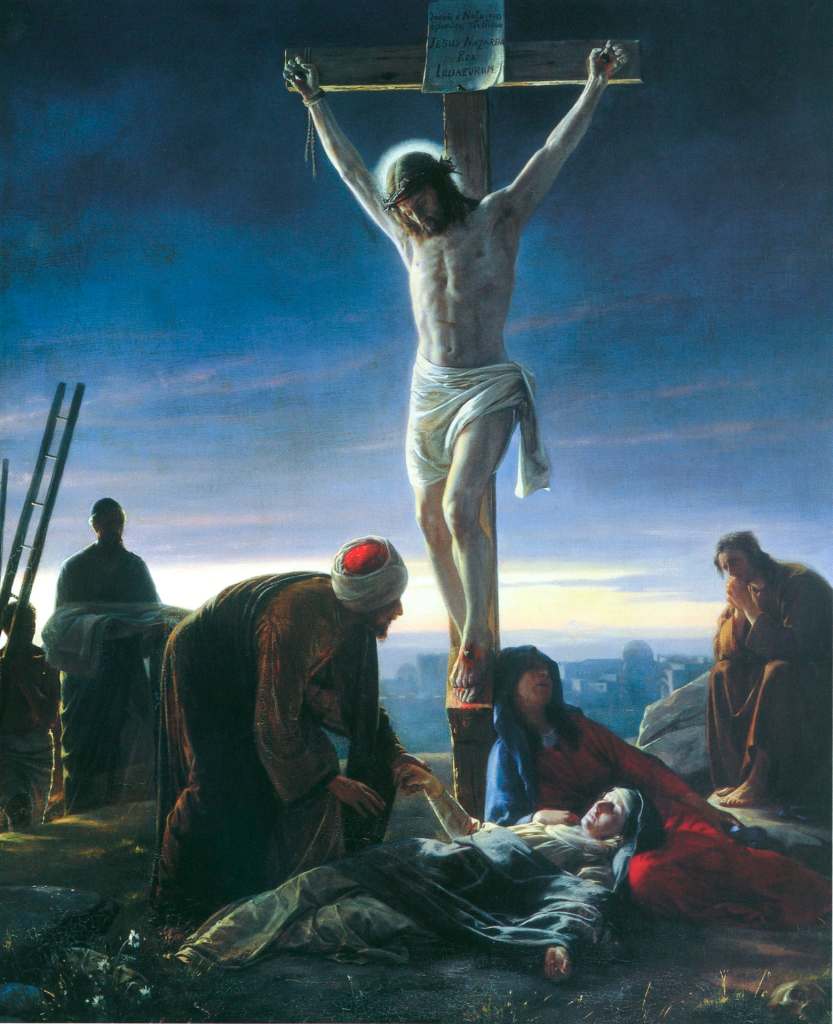
“The Crucifixion”, by Carl Heinrich Bloch (1834–1890)
“The Way to Emmaus” (1877), by Robert Zünd (1827–1909)

