Posting a copy of my latest response to Jessica L Scott here, since I think it contains some important clarifications:
Thank you for your response, Jessica. I am glad to see that you were not offended by what I said, and that we seem to be on more or the less same page when it comes to these topics. I know nothing about the Kafirs of the Hindu Kush, so I cannot comment on that now. As for the origins of the early «Canaanite» religion, that is a huge and complicated topic, as you know, but I would say that one important key to the enigma is provided by the simple and really rather obvious, but now frequently overlooked fact that the «Canaanites» are roughly identical to the «Phoenicians» spoken of by the ancient Greeks or Hellenes — a subject extensively treated of by the eminent scholar Sir George Rawlinson back in the 1800s, but later more or less deliberately ignored, probably because a study of the «Phoenician» issue quickly reveals that entities like «Israel» and «the Jews» are really nothing more and nothing less than branches of the «Phoenician» nation, and because it therefore undermines the radical exclusivism and exceptionalism and «manifest destiny» which the authors of the Torah and the Tanakh attempted to promulgate.
The «Phoenicians», moreover, were neither oppressed nor powerless when they were at the height of their power, but had colonies and trading posts all along the shores of the Mediterranean, as well as in Spain, and in Cornwall in Britain (where they owned huge tin mines), for example, and the City of Carthage had been founded by the exceedingly ancient and prosperous City of Tyre, if I remember correctly, the Tyre which was world-famous for the extremely expensive purple dye associated with royalty and initiation, and the burial customs of the «Carthaginians» are exceedingly similar to those seen outside of Jerusalem (I am thinking of the «tophets», for example), and the «Punic Wars» between Carthage and Rome were really a series of wars between the Phoenician Empire and the emerging Roman Empire.
Incidentally, Sigmund Freud sometimes called himself Hannibal, perhaps because he identified with the Carthaginian general of that name who came exceedingly close to conquering and wiping out the City of Rome.
So one can see how delving into Phoenician history quickly opens up all sorts of proverbial cans of worms.
As for eastern origins, Herodotus states that the Phoenicians originally came from the Erythraean Sea, and Aristotle claimed that the «Israelites» had their roots in India. The latter may not be entirely reliable, however, since he managed to misunderstand and misconstrue the teachings of his master, Plato, and since he may never have been initiated into the Greater Mysteries of Eleusis.
As for the territory allegedly given to the descendants of Abram by YHWH in Genesis 15, it just happens to be virtually identical to the territory held by the «Hyksos», when the Hyksos Empire had reached its greatest extent, since it stretches from the River of Egypt, the Nile, to the Euphrates. But that is just a coincidence, of course. 🙂
What may be of greater interest as regards origins is that the Creation Story found in the Indian Lawbook of Manu, a work which Sir William Jones deemed to be at least around three thousand years old, has so many points and ideas in common with the «Hebrew» Genesis that the two *must* be related in some way. The first part of Genesis reads like a simplified version of the first chapter of the work attributed to Manu. That this fact has not been discussed by a single Western scholar since Nietzsche brought the topic up in Germany in the 1800s, and that I only discovered it a few years ago, after having completed a degree in theology, is nothing short of astonishing.
That Indian Lawbook speaks of the Saraswati River as a real river, by the way, as in verse 11:78, where it states that one way to expiate one’s sins is to walk all the way to its distant sources while subsisting on certain wild grains only:
11:78. Or, eating only such wild grains as are offered to the gods, he may walk to the head of the river Saraswati [or Sarasvati] against the course of the stream; or, subsisting on very little food, he may thrice repeat the whole collection of Vedas, or the Rig, Yajur, and Saman.
I think you are right in claiming that sacred transposition is a real phenomenon. It is fairly obvious that it is. Whether the original Saraswati River is the river which allegedly dried up and vanished some four or five thousand years ago, or the river you speak of in your paper, the attributes of the Saraswati, such as the idea that it has its origin in the Realm of the Divine, were later transferred to the Ganga or Ganges. One question I would pose is this: If the ancient Saraswati is a river still flowing, in present-day Pakistan, then how come that the Indian civilization at some rather late stage substituted the Ganga for the Saraswati? It seems that some sort of great event or process must have been behind a change as dramatic as the exchanging of one huge river for another, and that migrations, whether of (Proto-)Indo-Europeans from the north or of (Proto-)Indo-Europeans within India itself, must also have been triggered by something.
In New Zealand, the ancient light-skinned and red- and blonde-haired people which was there long before the arrival of the Maoris, according to the legends of both the Maoris and that people, assert that this European-like people left «Persia» thousands of years ago. (C.f. the «Skeletons in the Cupboard» documentary series; many of the redheads were captured and eaten by cannibals centuries ago . . .) Could this strange migration, if it really happened, have been triggered by the same process which caused the Holy Saraswati to be abandoned?
As for sacred mountains, I was somewhat surprised to see that you did not mention the Vedic Mount Meru, which seems to be the mother of all such mountains. Both the Mount Olympus of the Hellenes and the Mount Zion of Israel are likely late reflections of the Mount Meru concept, which is not simply a tall mountain, but a vast, metaphysical structure, extending far into the universe like a pole or axis, and at the apex of which is found the abode of the cosmic gods. The late American Vedic scholar and mathematician Richard L. Thompson did some fascinating studies of Mount Meru and related topics back in the 20th century, and claimed to have found that the map of Meru and of «India» which may be derived from the sacred writings actually record, with an astounding degree of accuracy, the layout and the dimensions of our solar system, including the orbits of the various planets. Many of his lectures are still available online.
There is also the «Sumer» of the early Mesopotamian Civilization, of course, which sounds suspiciously like Su-Mer(u). The Sumerians also had a sacred mountain, but I am not sure what it was actually called. «Su» could perhaps be the ancient Indo-European word for south, «sud» — a word still in use here in Norway.
If one should feel inclined to venture even further away from the orthodox path, one might point out that there are indications that traditions pertaining to «antediluvian» times, and to Atlantis, were transposed to Mesopotamia, and to Sumer and Babylon. To quote from the paper by Amar Annus (2010) again:
There was a broad tradition in the Babylonian scribal milieu that the seventh antediluvian figure, a king or a sage, ascended to heaven and received insights into divine wisdom. The seventh antediluvian king according to several lists was Enmeduranki, the king of Sippar, who distinguished himself with divine knowledge from the gods Adad and Shamash (see Lambert 1998). Biblical scholars generally agree that the religious-historical background of the figure of Enoch, the seventh antediluvian patriarch in Gen. 5.23-24 and subsequently the apocalyptic authority in Enochic literature, lies in the seventh Mesopotamian antediluvian king Enmeduranki. (Page 2).
There are two different adaptations of Mesopotamian lore in Genesis in respect to the antediluvian history. One of them is positive and affirmative—the sequence of ten patriarchs before the flood is in accordance with the ten antediluvian kings of Mesopotamian mythology, including Enmeduranki (see Kvanvig 1988). The second adaptation is negative—the antediluvian sages, the Mesopotamian apkallus were demonized as the ‘sons of God’, and their sons Nephilim (Gen. 6.3-4), who in later Enochic literature appear as Watchers and giants, illegitimate teachers of humankind before the flood (see 1 En. 6–8). The Book of Watchers reconciles these two different adaptations by making Enoch in every respect superior to the Watchers. (Page 5).
Footnote:
7. Such a variant is attested in Berossus fragment F4b, where ‘all writings’ are buried in *Sippar, the city of the Sun god* before the flood (Burstein 1978: 20). For Jewish variants, see Jub. 8.3-4; Josephus, Ant. 1.68-71. (Page 8).
The Aramaic term for ‘Watchers’ (‘yr) must have come about as an adaptation of Akkadian term massaru, the term which denoted specialized guards for gates, doors, walls, and so on, but also divine guardians and their representations in private houses and temples.65 The verbal root ‘wr in Hebrew means ‘(to be) awake’, and Syriac ‘r, with participle ‘r means ‘(to be) awake, watch’. Hence the Aramaic term means ‘wakeful one’. The expression ‘yryn came to denote angelic beings, whether they are good or rebellious, or could be used neutrally to refer to angels in general (Stuckenbruck 1997: 84). (Page 38).
In other words, the great antediluvian monarchs were really «Atlantean» kings, as the monk Cosmas Indicopleustes inadvertently hints at, and the City of the Sun, «Sippar», was actually in Atlantis, not in Babylonia — and perhaps Mount Meru was also, in some sense, located on the other earth beyond the ocean, as Cosmas styles Atlantis, for some ancient writings seem to say that the Atlanteans were also called the Meroe.
What is downright weird is that the term «yr» is also found in Norwegian, where it is not only a noun denoting light rain, but an adjective denoting a state of light-headedness or excitement or ecstasy.
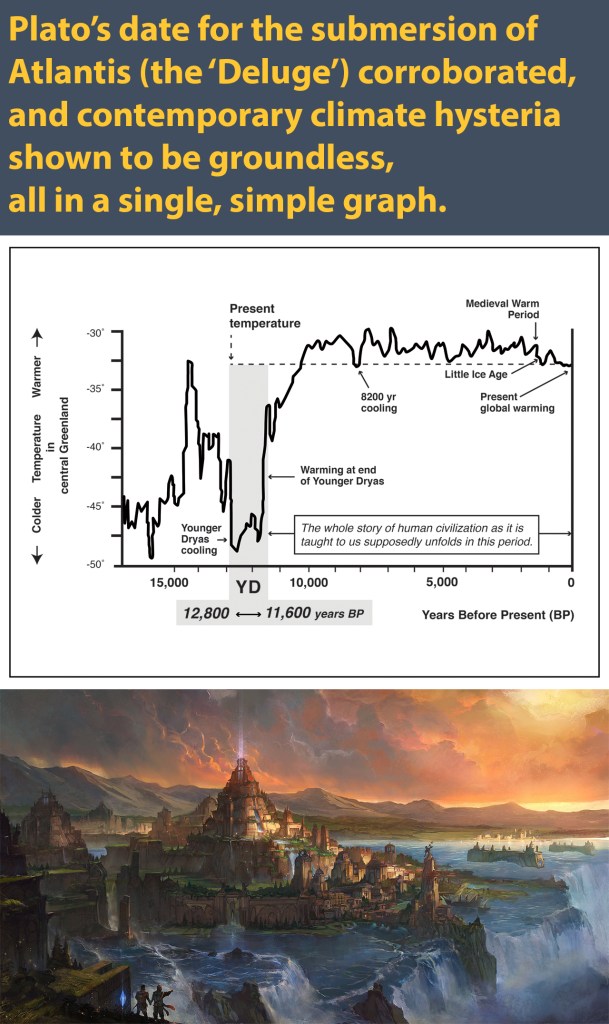
It is also curious that the great Indian epic, the Ramayana, which has the character of a fairy-tale, but which may contain historical elements, is actually about the great war between the good gods and the wicked titans (the devas and the asuras in Sanskrit?), which is a topic familiar to us from Greek «mythology», and that the titans have their foremost base on the island of Lanka, in much the same way that the late, degenerate Atlanteans spoken of by Plato have their base on his famous island, and that parts of the Ramayana would seem to speak of a great conflagration caused by a heavenly body (the «tail» of the god Hanuman), and of a great, watery cataclysm — events highly reminiscent of what we now know took place during the Younger Dryas era, between c. 12,800 and 11,600 years ago. (C.f. my post dealing with this subject made in 2024, as well as the work of Graham Hancock and Randall Carlson.)
Originally published as a post on my profile page at Academia.edu: https://www.academia.edu/community/le9GYw
It got 163 views, and three likes and three comments.