It is probably one of the most important questions a historian of the “West” can ask – due to the implications of whatever the truth of the matter is –, yet one of the most difficult to solve conclusively:
Did the Jesus (Greek: Iesous) of the Christian gospels, or someone more or less like him, ever exist as a real, historical, tangible human being, or were both the narratives and the sayings associated with the name of Jesus partly invented out of “whole cloth” and partly appropriated from or inspired by various ancient sources most people of today have little or no real familiarity with, such as the life of Socrates, the life of Apollonius of Tyana, the Eleusinian Mysteries, the Mithraic Mysteries, the myths of Egypt and of Mesopotamia, and so on and so forth?
Could it even be the case, moreover, if the latter option should turn out to be the true one, that the proverbial rabbit hole has yet another level to it, and that the Jesus character and his biographies were deliberately crafted, by a tiny cabal or clique of people, with the intention to tempt the peoples and tribes of Europe and the world to abandon their native, ancient ways and admit an alien deity into their midst, and to thus conquer them theologically and psychologically, and eventually also politically, as some have claimed?
Friedrich Nietzsche (1844–1900), that highly unconventional and provocative German thinker, certainly came very close to making that very assertion, back in the late 1800s.
The question of whether Jesus – Jesus Christ – ever actually lived and walked the earth has been asked innumerable times over the last two thousand years, and it has been asked with a new intensity and zeal since the outbreak of the empirically oriented Protestant Revolution, also known as the Reformation, which reacted to corruption and cruelty and wastefulness, and which wanted to return to “the sources”, but which, gradually, tore the entire “Holy Bible” to pieces in its quest for an “authentic” and “unadulterated” core of primal Christian history and faith, and which very nearly tore Europe and European Civilization to pieces as well, by either giving rise to or aiding the development of (1) the weird and gloomy extremes of Calvinism and (later) of Northern Pietism, (2) the replacement of transcendent and sublime philosophical rationalism and realism with worldly nominalism and empiricism, (3) the transition from rural feudalism and the rule of Monarchs to urbanism and commercialism and the rule of Money, (4) the largely justified but too anti-supernatural textual analysis movement known by the strangely inappropriate label of “Higher Criticism”, (5) the partial or even wholesale rejection of Christian Platonism, the true lifeblood of and the real philosophical justification for and foundation of the Christianity founded by the more intelligent of the saintly Church Fathers (such as St. Augustine of Hippo), and (6) the creeping theological substitution of Life in this World as a Pilgrimage, aimed at the Kingdom of the Heavens, with very different pilgrimages to a terrestrial and worldly Zion, aimed not at an otherworldly Heaven, but at a carnal “heaven” here on this present, material Earth.
How, after all that, and much more – all the fanaticism, all the zealotry, all the iconoclasm, all the tearing down of old temples, all the rewriting of history, all the false and absurd history, all the dastardly power games, all the dirty politics, all the forced conversions, all the subtle mind games, all the sweeping doomsday scares, all the oscillation between extremes; between theses and anti-theses, all the dreadful disappointments, all the broken promises, all the gruesome wars, all the insufferable arrogance and haughtiness, all the violent intolerance, all the unwarranted dichotomies, all the psychological projection, all the boredom, all the freedom, all the serfdom, all the twists and turns of Christendom – how, I say, after such a gargantuan and bizarre agglomeration of good and bad and all too human happenings, could one not be tempted to ask the following blunt question:
Was it all baloney?
Or did it all begin with a real person, who did something extraordinary (whatever it was), and who sparked such widespread amazement, and such outrage in high places, that history simply could not remain unaffected, and that someone simply had to deal rather decisively with not only the man himself – if man he was –, but also with his followers and his legacy?
Was he perhaps, eventually, as time went on, and as the ultimate act of defamation and revenge, cleverly portrayed as a advocate for and a representative of the very powers and principalities he so ardently sought to oppose?
Could it be that not only his theology, if he actually had one, but his ancestry, was misrepresented and falsified?
Can the essence of whatever it was he taught and aimed for ever be extricated from all the large and small accretions, and all the later glosses and insertions and rewordings?
Or would it be wiser to just give up the whole quest for the “historical Jesus”, and make a conscious, bold decision to change over to the clarity and cleanliness of ancient, pre-Christian Platonism (which has its roots in Pythagoreanism), or to the contemplative and comparatively peaceful Dharmic Vedism of Northern India?
When seen in a wider perspective, there is little or nothing in his teachings – at least not in those which are known to us, and in the form they have come down to us – which is very original or exceptional or “revolutionary” (with the possible exception of those we may catch glimpses of those of the sayings attributed to him that deal with the enigmatic relationship between him and his divine Father, who is certainly not YHWH, and some of those constituting the Sermon on the Mount). They do not constitute Divine Revelation – not in the sense of presenting something entirely new to the whole world. Virtually all the more noteworthy ethical and theological and philosophical precepts attributed to him, including the ones I strongly suspect constituted his most important doctrine and injunction, were anticipated by Socrates and Plato, and may be found scattered about in Platonic dialogues like the Gorgias and the “Republic” (texts which very few people bother to read from beginning to end nowadays even in translation). This means that these concepts and ideas would have been fairly widely known in the Greco-Roman and Phoenician world, the world of the Mediterranean and beyond, centuries before the supposed Nativity of The Savior.
If there is anything truly remarkable about the Christ, whether the Christ of literature and of myth (consult C. S. Lewis for thoughtful considerations of the significance of the myth) or the possible Christ of history is intended, it lies in his nature, or in his charisma, or in his manner of teaching and presenting (some of the sayings attributed to him are remarkably pithy and witty), or in his acts, or in his life and death, or in all of these. His emphasis on Selfless Love, on Non-Violence, on Reciprocity, on the Inner Life of Man and on the Majesty of his mysterious Father (whom I have come to view as the First Principle, and not as the YHWH of the Old Testament, whose nature is fundamentally irreconcilable with that of the Jesus of the gospels) is strong, but not unique or unprecedented. It is markedly different from the contents of the Old Testament or Tanakh, generally speaking, and it may have been viewed as somewhat extraordinary in the Judea and Galilee of the first century A.D. – and perhaps that was why he allegedly said that he had only been sent to the Lost Sheep of the House of Israel (Matthew 15:24; maybe only some of the members of the nation of Israel were so deluded and stiff-necked that they were in need of a Jesus to shake them up and bring them to their senses) – but it is not very novel or ground-breaking at all if ancient Greece and India and Egypt are taken into consideration.
As I have said before, the Christ of the gospels has long struck me as a sort of “Galilean Socrates”. Not only do Socrates and Christ share the “turn-the-other-cheek”-doctrine (set forth by the former in Plato’s Gorgias) and the concept of a Heavenly Kingdom or Spiritual Realm Within (as opposed to a monarchy in the empirical, material world; the world of the five bodily senses; Plato’s realm of genesis or generation; see his “Republic”) – the ends or finales of their lives both involve a terrible, dark cup (a real one in the case of Socrates, a metaphorical one in the case of Jesus), an audacious betrayal, a cock (before the trial in the case of Jesus, at the point of death in the case of Socrates; both could be an allusion to Asclepius, a god of healing, to Rebirth, and to the Sun), an dubious accusation of blasphemy, and of leading the people (the Athenians in the case of Socrates) astray, a disturbing trial (the outcome of which is decided by “democracy”), horrified disciples (Plato and others in the case of Socrates) and a heartbreakingly sad and tragic death, and a death which is not death in the sense of annihilation, but a prelude to Liberation (individual in the case of Athens, more collective in the case of Calvary).
Parallel Lives, as Plutarch (the priest) called the phenomenon of similar lives (and the title of his great work), are not unheard of in history, however, so these similarities need not mean that the canonical Jesus-narratives were inspired by or influenced by Plato’s Apology and Phaedo, of course.
Now I will finally attempt to provide an response, or at least a partial response, to the question with which this little treatise of mine began:
Did the Jesus of the Christian gospels, or someone more or less like him, ever exist as a real, historical, tangible human being?
To my mind, this question can only, if at all, be decided by a careful and disinterested look at the historical evidence, and since centuries of textual criticism have demonstrated beyond the shadow of a doubt that the canonical gospels and the rest of the texts making up the New Testament, to make a very long and complicated story very short, cannot be taken at face value, at least not in their entirety, have been partially altered and manipulated and adulterated, and sometimes even contradict one another, we have to look beyond the New Testament if we want to have any chance of arriving at a relatively reliable conclusion.
(The same is true of the Old Testament, the Tanakh, of course.)
But the veracity of some of the early church fathers has also been called into question. So where does that leave us?
One often hears that there is no real evidence for a historical Jesus beyond the conventional Christian texts – which are not viewed as evidence by their critics. This is not actually the case, though, for there is in fact a most prominent non-Christian work containing some exceedingly strong indications that a historical Jesus, in some ways resembling the Jesus familiar to us from the gospels, really existed. The “problem” is that these indications are found in the to most Christians o-so-taboo Jewish Talmud, that they tend to portray Jesus, who is demonstrably sometimes spoken of by way of “code names” in a very unflattering and derogatory way (in the way the Pharisees of the gospels might have portrayed him, one might say), and that they give the lie to the widespread modern claim that Jesus was “a Jew”, or “Jewish” (in a meaningful, religious sense), and expose the label “Judeo-Christian” for the oxymoron that it is.
The Talmudic tradition singled out by Rev. Dr. David Instone-Brewer (in his fascinating little paper “Jesus of Nazareth’s Trial in Sanhedrin 43a” (an older version the paper can be found here), which may be downloaded for free from his profile page here on Academia.edu) as one of the earliest and most authentic (possibly going all the way back to the lifetime of Jesus himself) simply reads like this:
“It was taught: On the Eve of Passover they hung Yeshu the Notzarine. And the herald went out before him for 40 days [saying]: ‘Yeshu the Notzarine will go out to be stoned for sorcery and misleading and enticing Israel [to idolatry]. Any who knows [anything] in his defence must come and declare concerning him.’ But no-one came to his defence so they hung him on the Eve of Passover.” (Instone-Brewer, 2011, p. 5)
This passage is only found in a complete form in the one surviving uncensored version of the Babylonian Talmud, the so-called “Munich Talmud”, and the term “Yeshu the Notzarine” is very faint, indicating that someone once attempted to erase it – fortunately without success.
The emphasis in the above quote indicates what Dr. Instone-Brewer believes to be the original core of this rabbinic tradition, while the words in grey represent the words in the original “Hebrew” that have almost been removed, and which are only barely legible.
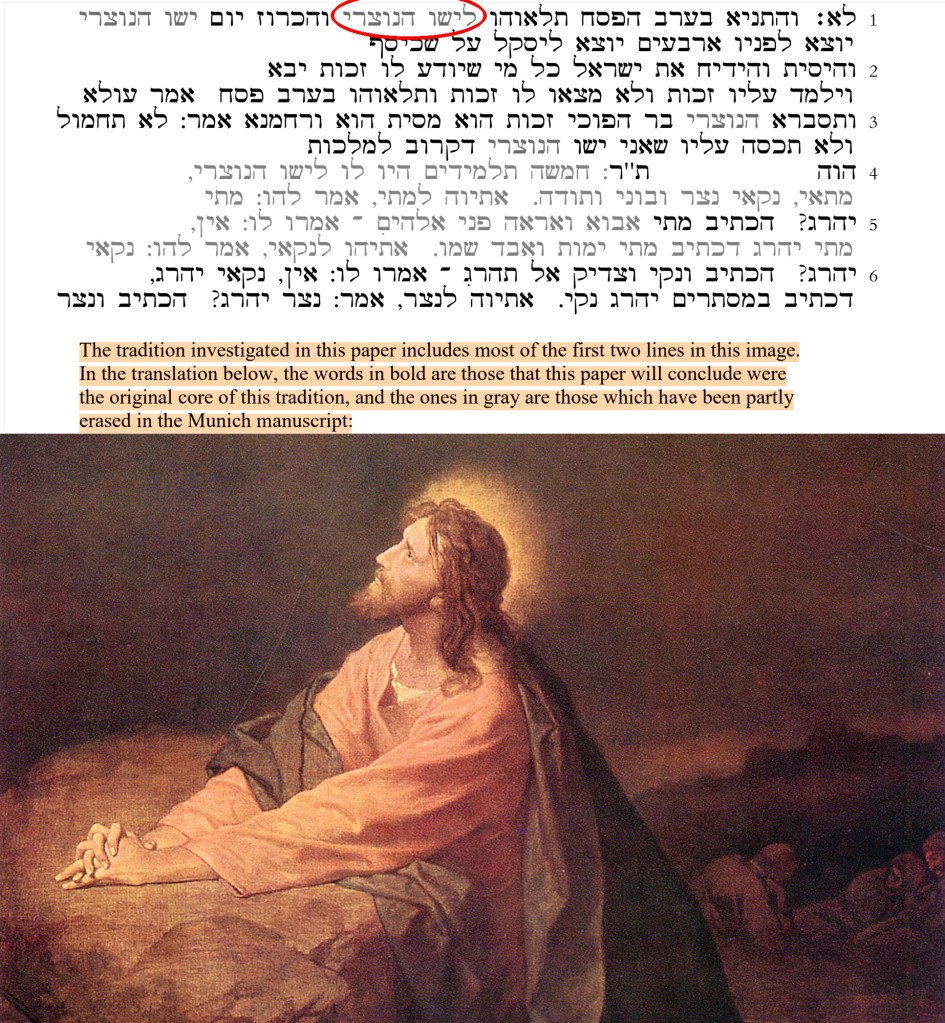
In my opinion the fact that these mentions of and references to a “Yeshu ha-Notzeri” (“the Notzarine” is an Anglicization of the “Hebrew” term), who is clearly the same person as the one appearing in the gospel narratives, come from a camp more or less hostile to Jesus and to Christianity, make them all the more interesting, since there is no reason to believe that the Jewish authors simply invented these, or composed all of them as a mere polemical response to the Christian scriptures many of them so detested. Such claims are, to put it very politely, “BS”, aimed at discouraging gentile (goy) inquiry into what the Talmud actually says of “Yeshu”.
The Talmudic evidence hits both ways, however, since it indicates that the canonical gospel narratives are heavily romanticized versions of the real story.
Here are a few more direct quotes from Dr. Instone-Brewer’s important essay:
The Munich Talmud is therefore the only uncensored copy of the whole Talmud, though even this is censored in some respects. The name of Jesus and other words are frequently very faint, as though someone has attempted to erase them. In the passage about Jesus’ trial, the two occurrences of the name “Yeshu ha-Notzeri” have been partially erased in this way, as well as parts of the following passage about the names of his disciples. However, the original Hebrew is still visible, and it has been reconstructed by close examination of the manuscript. These reconstructions are usefully collected in an appendix by Herford.
The name of Jesus does not always occur in censored passages. Some refer to “Ben Stada” or “Ben Pandira” (or Panthera), but there is good evidence that these are pseudonyms for Jesus in such passages. In b.San.67a both these names are used for the same person who is described as “hung on the Eve of Passover” – the same phrase which is used of Yeshu ha-Notzeri in b.San.43a. Also, Tosephta refers to “Yeshu ben Pandira”, and it has a story about a follower of him, Jacob of Kephar Sekhania who met Eliezer b. Hyrcanus (late 1st or early 2nd C) in Sepphoris near Nazareth (t.Hull.2:23). Tosephta’s version of this story says that he taught Eliezer a saying of the minim. The saying itself is found at b.AZ.17a, where the Munich Talmud attributes it to “Yeshu ha-Notzeri”.
(Instone-Brewer, 2011, p. 3, emphasis added)
When later Talmudic rabbis debated these names, they concluded that the same person was called both “ben Stada” and “ben Pandira” because one was the name of his mother’s husband and the other was her lover, so they concluded that Yeshu was illegitimate. One rabbi thought that “Stada” was the name of his mother, because it is similar to saṭat (“unfaithful”), but others pointed out that her name was actually Miriam – i.e. Mary (b.Shab.104b). Modern scholars have concluded that these multiple names represent more than one individual who have become confused.
The pre-history of these traditions is probably impossible to trace. However, it is unlikely that more than one person was “hung on Passover Eve”, and we have independent sources to confirm that this referred to Jesus. Therefore it is likely that the common factor which caused these individuals to become confused with each other was the charge of sorcery. (Instone-Brewer, 2011, p. 3, emphasis added)
The passage about Jesus’ trial at b.San.43a is unique among them because it appears to contain a tradition which dates back to the time of Jesus. The tradition, as preserved in Talmud, has clearly been edited later, but it is likely that the original words have survived. The common pattern of editing in rabbinic traditions is to expand the text while leaving the original words unaltered.
(Instone-Brewer, 2011, p. 4, emphasis added)
The tradition investigated in this paper includes most of the first two lines in this image. In the translation below, the words in bold are those that this paper will conclude were the original core of this tradition, and the ones in grey are those which have been partly erased in the Munich manuscript:
It was taught: On the Eve of Passover they hung Yeshu the Notzarine. And the herald went out before him for 40 days [saying]: “Yeshu the Notzarine will go out to be stoned for sorcery and misleading and enticing Israel [to idolatry]. Any who knows [anything] in his defence must come and declare concerning him.” But no-one came to his defence so they hung him on the Eve of Passover. Other manuscripts which have this tradition contain a few variants. The Florence MS has “on the Eve of Shabbat and Eve of Passover” and only the Munich MS includes “haNotzeri”.
(Instone-Brewer, 2011, p. 5)
The tradition of Jesus’ trial has been partially preserved in four other sources: 1) Another censored passage at b.San.67a includes the words “on the eve of Passover they hung …”, followed by other names used for Jesus, “Ben Stada” and “Ben Pandira”. 2+3)
The words “for sorcery and enticing Israel” occur at Sanhedrin 107b with a parallel at Sotah 47a. 4)
Outside the Talmud, two charges are recorded by Justin Martyr, who said that as a result of Jesus’ miracles, the Jews “dared to call him a magician and an enticer of the people” (…).
Stanton pointed out that these two charges also occur together in the 3rd century Acts of Thomas, where Thomas is charged with them, though clearly as a proxy for Jesus. They also occur in Josephus’ Testamonium but this is widely believed to be a Christian addition of unknown date.
The name in this tradition varies in different sources and manuscripts, “Yeshu”, “Yeshu ha-Notzeri”, “Ben Stada” or “Ben Pandira”. This makes it possible that this tradition originally referred to someone other than Jesus. However, this is very unlikely because of the strange date for the execution (which is strongly linked with Jesus traditions in the Gospels), and because the names “Ben Stada” and “Ben Pandira” are elsewhere linked with each other and with the name of Jesus in phrases such as “Yeshu ben Pandira” (t.Hull.2:23).
(Instone-Brewer, 2011, p. 9, emphasis added)
These various sources which contain parts of the tradition about Jesus’ trial show that this tradition was widely known and well preserved. The Talmudic sources are difficult to date because although some named rabbis are involved, they are citing older traditions and, as often occurs, the origin of these traditions is not identified. Justin is writing at about AD 150, and he appears to be citing something which is common knowledge because he makes no effort to verify it for his Jewish opponent whom he is addressing.
We therefore have confirmation from three rabbinic sources and one Christian source for the words: “On the eve of Passover they hung Yeshu for sorcery and enticing Israel”. The fact that these words form a coherent tradition by themselves makes it possible that this was the historic core from which the rest has resulted by the addition of explanatory comments. The fact that the other words cannot be paralleled elsewhere is not an indication by itself that they originated later than this core tradition, but there are internal criteria which do suggest that this was the case.
(Instone-Brewer, 2011, p. 10)
The first problem Jews faced was the date of the trial and execution. The Passover Eve refers to the whole day preceding the Passover meal on the evening of the 14th of Nisan, much like Christmas Eve refers to a whole day. Although this was not officially part of the Passover Festival, it grew in importance when the law about unleavened bread became a household search and clearout of every crumb of leaven. This became a central part of Passover after the destruction of the Temple in 70 CE, when the sacrifice of a lamb became impossible, but it was already important in Temple times. A timetable was instituted by which leaven had to be found by noon on Passover Eve, and a signal was given at the Temple when this search should end (m.Pes.1.5). The School of Shammai (which effectively disappeared after 70 CE) agreed with the School of Hillel that the whole day should be devoted to searching for leaven so no other work should occur (m.Pes.1.1; 4.5). This meant, in effect, that the whole day of Passover Eve was devoted to sacred tasks and it was certainly not the right time for a trial or an execution.
We have no evidence that this date would be illegal for a trial, but it is certainly not a date which would be chosen by any court interested in observing Jewish customs.
(Instone-Brewer, 2011, p. 12)
The second problem in this core tradition is the suggestion that the execution was by hanging rather than by being stoned, as prescribed by Torah and Mishnah. Torah was very clear that stoning was the punishment for “enticing” (Deut.13.6–10) and it prescribes a death penalty for “sorcery” though the method of execution is not prescribed (Ex.22.18; Deut.18.10). However, in a second-century debate, the rabbis concluded that sorcery was punished by stoning, partly because the sorceress is listed alongside the woman guilty of bestiality which was punishable by stoning (see the debate at b.San.67a). Mishnah makes a tidy list of crimes which are punished by stoning, including “sorcery”, “enticing” and “misleading” (m.San.7.4).
The term “hang” could refer to execution by hanging from the neck, execution by crucifixion, or the hanging of a corpse after another form of execution. Without any reference to another form of execution, the assumption in the first or second century would be that “hang” refers to crucifixion.
(Instone-Brewer, 2011, p. 12)
This conclusion would create problems in the second century when Judaism was attempting to follow a uniform rabbinic halakha. They sometimes re-interpreted history to imply that this halakha had been followed by everyone before 70 CE when Judaism was a world of disparate factions. For example, they taught that the Sadducean priests had been forced by the Pharisees to obey this halakha. They would therefore like to believe that executions were carried out in accordance with rabbinic halakha. However, Jews in the first century had a more realistic understanding of what was possible – the Romans were in charge of capital punishment, and they chose the method of execution.
(Instone-Brewer, 2011, p. 13, emphasis added)
Footnote, page 2:
Paul L. B. Drach, De l’harmonie entre l’Eglise et la synagogue, ou, Perpétuité et catholicité de la religion chrétienne (Paris: P. Mellier, 1844), I p. 168, cites an encyclical from Poland in 1631:
“we enjoin you, under the pain of excommunication major, to print nothing in future editions, whether of Mishna or of the Gemara, which relates whether for good or evil to the acts of Jesus the Nazarene, and to substitute instead a circle like this ‘O’, which will warn the Rabbis and schoolmasters to teach the young these passages only viva voce. By means of this precaution the savants amongst the Nazarenes will have no further pretext to attack us on this subject.” (Instone-Brewer, 2011, p. 2, emphasis added)
Explanatory notes (by Edmund Schilvold):
Minim: “Minim” is a “Hebrew” term in the plural, a term which has the general meaning of “heretics”, and which is sometimes, as in the passage in the Tosefta referred to by Instone-Brewer above, clearly used to refer to early Christians, or to followers of “Yeshu”. Its most controversial and debated use is found in the so-called Birkat ha-Minim, a birkat/birkath or “blessing” which is actually a curse, and which forms a part of the so-called Eighteen Benedictions, a prayer which plays a central part in the everyday life of many religious Jews.
Viva voce: Only “viva voce” means orally only, or exclusively by way of speech.
To be continued …
The second part may be read here …
Comments made on this post at Academia.edu:
Comment made by Jessica L Scott:
Interesting read!!! I did not celebrate Pesach this year but I still identify culturally as Jewish. I have read Josephus’ works, and found this very fascinating. 🙂 Great job.
My response to Jessica L Scott:
Thank you for that very kind comment, Jessica, and thank you for your open-mindedness and your intellectual curiosity as well. I tried fairly hard to find your new Voynich Manuscript publication on Amazon, by the way, but none of my several searches yielded the desired result, so perhaps you should include a direct link in your next post?
As for Flavius Josephus, I have read his account of the war between parts of Israel and the Romans (which is an exciting, but probably somewhat biased account), but not his “Antiquities of the Jews”, which I have heard contains some very interesting remarks.
I didn’t go into the topic of the Judean insurrection in this post, but I tend to give some credence to the theory that the canonical Christian gospels, in the form they have come down to us, also make use of themes from the uprising against Roman overlordship in the 60s A.D. In other words, the original story of the life and the acts of “Yeshu ha-Notzeri” or Iesous the Nazarine/Nazarite (?) was either deliberately or accidentally merged with the life and the acts of one or more of the personages associated with the “Jewish Revolt”, which, according to Josephus, I think, ended with the public crucifixion of several of the leaders of that rebellion.
The English independent researcher and author and traveller Ralph Ellis has treated of that subject in great detail, but goes further in his conclusions than the evidence actually allows for, in my view. He believes that a forgotten kingdom of Edessa, and a prince called Izas Manu played a central role in the war, and that “St. Paul” is really a “pen name” of Josephus, for example.
I wish you an excellent early spring week, however you choose to celebrate it.
Response by Jessica L Scott:
“Edmund Schilvold: As always, well-thought out answers! Oh, and yes it hasn’t gone live yet.”
Comment made by Diana A Chelmuș:
“And you think Jesus is inocente and he is replacing another person?”
My response to Diana A Chelmuș:
My persistent intuition tells me that he was innocent, in much the same way that Socrates was innocent. Both may have been “guilty” of putting lesser deities in their proper place, of “subverting” a religion and a societal order which was in need of reform, and of making a lot of arrogant and self-centred people very angry, and Jesus may perhaps have used whatever it was he became acquainted with in Egypt (c.f. the uncensored Munich Talmud again) to carry out “miracles” or acts of “magic”, such as some of those mentioned in the gospels, but then that was white magic, not black magic, and how could a man professing such lofty and admirable doctrines as Jesus did, if he indeed existed, be truly guilty of any grave evil?
He likely condemned the behavior of YHWH, as set forth in parts of the Old Testament, and the behavior of “the Scribes and the Pharisees”, but he did not blaspheme the Most High God (who, according to the Tanakh itself, gave to the various peoples of the world their respective deities or angels), nor did he vilify all Israelites.
My reason or dianoia tells me that we simply cannot know for certain what took place, however, since the present evidence and state of scholarship do not allow us to come to a definite conclusion. But then the Platonist puts Nous above Dianoia.
As for replacement, you may perhaps be thinking of the Islamic assertion that it was not Jesus (Isa) who was crucified on the cross, but someone resembling him, and Jesus himself did not die at all, but was taken up into Heaven:
Quote from the Quran:
And [We cursed them] for their disbelief and their saying against Mary a great slander, And [for] their saying, “Indeed, we have killed the Messiah, Jesus, the son of Mary, the messenger of Allah.” And they did not kill him, nor did they crucify him; but [another] was made to resemble him to them. And indeed, those who differ over it are in doubt about it. They have no knowledge of it except the following of assumption. And they did not kill him, for certain. Rather, Allah raised him to Himself. And ever is Allah Exalted in Might and Wise. And there is none from the People of the Scripture but that he will surely believe in Jesus before his death. And on the Day of Resurrection he will be against them a witness.
Source: https://legacy.quran.com/4
Comment made by Diana A Chelmuș:
“Edmund Schilvold: Who invented goodness on the world?”
My response to Diana A Chelmuș:
Dear Diana A Chelmuș, you have a way of asking these curious yet profound questions, somewhat reminiscent of the puzzling responses given by the ancient oracles of Delphi and Dodona to the various inquiries they received … You know that I am a Platonist, and you have probably read my interpretations of Plato’s “Republic” (his Politeia), and so, you know what my response would be, as far as theology is concerned.
The Nature of Plato’s Good Revealed: Platonic Theology and Its Relation to
Christianity and Judaism
The Hidden Pentality of Plato’s Republic (PhD Project Proposal): Uncovering the Complex Buried Meaning Embedded in Plato’s Greatest Dialogue
The Idea of the Good, the Higher, Otherworldly, Truly Heavenly Sun, illuminating the Realm of all the lesser Ideas, the Realm that is the Upper Section of the Realm of the Intelligible or Noetic (c.f. Socrates exposition of the Divided Line in Plato’s “Republic”), is an Idea which never began or ceased to be, but always is, and this Good is the only perfectly good and fully real Good there is, and since this Idea of the Good is the perpetual provider (the literal meaning of “pro-vid” is “prior to vision”) of both Truth and Nous, and the ancient Greek term idea (originally the Indo-European term “videa”) can also mean, and in this case clearly does mean, Beautiful Appearance or Countenance, and that which is genuinely Good is also beautiful and true, and that which is genuinely beautiful is also true and good, since Beauty, as a phenomenon, is a manifestation of Truth of Goodness, and that which is genuinely true is also beautiful and good, this Hidden Sun is not only Good, but also true and beautiful.
Yet even this Idea is not the Ultimate End, not in the sense of being the First Cause, for beyond this Luminous Countenance of the Good is the Good Itself, which is identical to the One Itself, and this One is the Mysterious Father, of whom Socrates so memorably refuses to speak while conversing with Glaukon (c.f. my essay The Nature of Plato’s Good Revealed), because nothing about it may be described, while its Idea is the Eternally Begotten metaphorical Child or Offspring, which is not begotten by way of procreation, but by way of a continual Overflowing or Emanation, and this combination of an Unknowable First Principle or “Darkness” and the very first Going Forth of that Principle – not “first” in a chronological sense, but in a hierarchical sense – was, according to some, at the core of all the more sophisticated ancient theologies, and at the heart of the alleged Secret Doctrine, and it is indeed found not only in Plato, but in Egypt (in the “solar” theology far predating the convulsions of the 1300s B.C.) and in India (Vedism), some four millennia ago, and it was inherited by early Christianity (which did not have the same type of trinitarian theology as was later developed and enforced), and by Esoteric Judaism (the Ein Sof and the Ohr Ein Sof), and I believe this doctrine to be the reason why St. Augustine states that Christ, in the capacity of the Eternal Word, which he views as identical to the Wisdom of God, is a Pure Emanation of Clear Light, and why he also makes the extraordinary claim that Christianity always existed (again, see my paper The Nature of Plato’s Good Revealed).
But the One is not good in a worldly sense, of course, not is it a one in the way humans tend to conceive of a one. As Proclus, one of the last of the great ancient Platonists, explains in his On the Theology of Plato (translated by the English Platonist Thomas Taylor, and finally digitized, about two hundred years later, by the Dutch philosopher Martin Euser): The One is called one by Man because it is the Source of all Oneness and Wholeness on the planes below it, or in the worlds being irradiated by it, and it is styled good by Man because it is the Ultimate End or Goal or Telos for which all Creatures yearn, whether they know it or not, and to which all are destined to return; the Beloved of which all lesser Loves are semblances, and without which none can be made perfect or complete (paraphrase).
You are probably also aware of that striking, startling, unforgettable rebuke uttered by the Christ of the gospels, involving the Good, when a man, or, according to Luke, an archon or ruler, came asking him what he should do to inherit eternal or (if we attempt a literal translation of the Greek) “age-long” life, a rebuke which I take as being both jocular and deadly serious:
Why do you call me good? No one is good (agathos) but the God (ho Theos) alone!”
This saying, in so perfect accordance with Platonism, is attributed to Christ by both Matthew, Mark and Luke, and the occurrence of a saying in more than one gospel tends to be interpreted by scholars of the Christian Bible as a sign of authenticity.
I hope this was not too much like one of those long and condescending sermons of old, for I am simply trying to summarize and express what I realized and what I saw before my inner eye, in a wonderfully vivid way, when I was working on my master’s thesis (in 2019 and 2020) – and yes, much of what I have said of Platonic theology was anticipated or hinted at by the American Platonist Dr. Pierre Grimes, half a century ago.
There is little innovation in the realm of Platonic philosophy, because Plato is so difficult to surpass; we are all disciples of the White Swan of Greece (c.f. Socrates’ dream, described by Diogenes Laertius, in his Lives of Eminent Philosophers), and with that we are, or ought to be, content.
But just as Dr. Grimes put Plato’s True Philosophy in a clearer and more attractive light (to allude to the words attributed by Porphyry to Longinus’, when the latter attempted to sum up what Plotinus had done for Plato) than anyone born in the 20th century whom I am aware of, by returning to antiquity and rejecting modern “nothing-buttery”, I have the humble ambition of rescuing Plato from the clutches of 21st century materialists and reductionists and blockheads and detractors, by incarnating his thought into this present day and age.
Comment made by Wurx Beaufort:
RE: “… the creeping theological substitution of Life in this World as a Pilgrimage, aimed at the Kingdom of the Heavens, with very different pilgrimages to a terrestrial and worldly Zion, aimed not at an otherworldly Heaven, but at a carnal “heaven” here on this present Earth.
I am interested in this theme and what others will say here.
RE: “… Or would it be wiser to just give up the whole quest for the ‘historical Jesus’, and make a conscious, bold decision to change over to clarity and cleanliness of ancient, pre-Christian Platonism (which has its roots in Pythagoreanism), or to the contemplative and comparatively peaceful Dharmic Vedism of Northern India?”
I do NOT want to become too distracted by alleged “proofs” that detract from the wisdom in the ‘kingdom is NOW’, this IS how it works, and the inclusiveness of the “love” messages. My intuition at this point is that the “love” messages are more clearly defined and central to a “Jesus” method [like Mahayana] than the more vague inferences in Plato, Hindu, Taoist, or Buddhist philosophical traditions.
The wisdom in these “love” messages is more immediate, more tangible, and more based in biology than in intellectual speculation. My bias is that the wisdom of these messages transcends and is not reliant upon a brief visit by an extraterrestrial or metaphysical entity. My bias eschews proofs by authoritarians claiming ownership of a “revelation” to a select few is ultimate and superior the child-mind marvelling at the caterpillar, the butterfly, and how these are related.
PLUS: YOU write in a very balanced and thought-filled style.
Response to Wurx Beaufort:
Dear Wurx Beaufort, thank you for your comments and your thoughts. Regarding your first remark: If we generalize and simplify a bit, we can distinguish between the following two kinds of religion and of religio-philosophical systems: (1) The class or category emphasizing and focusing on the Human Individual, on the Inner, Mental-Psychological Life of the Human Being, on the metaphorical Kingdom or Spiritual Realm Within, and Personal, Individual Growth and Development and Transformation, and on Individual Salvation or Liberation or Union with the Divine, attained to via the metaphorical walking of an Inner, Psychological Path or Road, and (2) the class or category centered around and preoccupied with the Collective, with the Group, with Social Classes and Social Issues, with the Outer, External, Material World, the World of the Five Bodily Senses, and with the world as we now have it, with the transformation of this world into a different and allegedly better one, by way of human and societal effort, as opposed to supernatural, divine intervention, and with the realization of some sort of worldly, earthly kingdom or state in this material world – a Utopia, if you will – the realization of which is also viewed as Salvation or Liberation, and even as Unification with the Divine, but in a communal or tribal sense, not in an individual sense.
While the first type, characterized by the emphasis on the Inner Life, and on Theosis or Union with God via the walking of the Inner Path, and therefore by Introspection and Yoga and Contemplation, spiritualizes human existence and the world, and yearns for the otherworldly, and for the Next Life, or the Next Phase of the Life of the Psyche – the Phase when Salvation has been attainted to by the non-biological Individual, which is the True Individual – tends to lead to a fairly peaceful and stable society, remaining more or less the same over the course of the centuries, precisely because the focus is on the Individual, and on Individual Improvement, the second type, characterized by the emphasis on the Outer World, and on the improvement or transformation of that material world by way of some sort of large-scale effort or grand project or revolution, and therefore by practical action and collectivism, materializes human existence and the world, longs for or lusts for that which is of this world, and for that which belongs to the physical, biological body, and for the power and prosperity and control which the hoped-for future kingdom or Utopia will usher in, and will often snark and scoff at the alleged “dualism” (a term fashionable in academic circles these days), the “meaningless propositions” (c.f. Logical “Positivism”), the “nonsense”, the “romanticism”, the metaphysical claims, the invisible supposed results, the dreamy otherworldliness and the belief in an Afterlife and in other planes and realms characterizing category one, and might even attempt to subvert and undermine and discredit and ridicule both the people belonging to it and their systems, since those adhering to the second type view the first type as an impediment or obstacle to the forging of the future Utopia, and to the collective projects required to bring that improved world about.
Paradoxically, however, the category two systems are doomed to failure, eventually, not only because they have a naïve and unrealistic view of the nature of this physical, material world – due to the fact that their adherents are infatuated with its excitements and its pleasures – but also because human beings, as C. S. Lewis so rightly observed, need the belief in and the hope of the Immorality of the Soul, the Afterlife and the Divine in order to live the best possible life in and make the most of life in this world, and because this present world is a world of flux, where nothing lasts forever, and is destined for a destruction which no amount of human effort can avert, in the sense of future, astronomical cataclysms involving first the solar system (the death of the physical Sun) and then the entire physical Universe.
The above is only a quick attempt to draw an outline of a situation which could easily be made the topic of a book, or a series of books, and which, in my view (a view based on some twenty years of ever-deepening intellectual inquiries and reflections) is extremely, exceedingly important for grasp, not only for the sake of one’s own, individual wellbeing and future Salvation or Liberation, but for the sake of the future of humanity and the world, for the difference between and the divide between and the conflict between these two categories, one and two, is not only one of the great themes of human history – where it can be observed in and helps illuminate the demise of the High Civilization of Sumer, the recurring conflicts in ancient Egypt, the intellectual disputes between the philosophical schools of Northern India, the resistance to Hellenization in the Middle East, the conflict between Jesus and the Pharisees in the gospels, the conflicts within Roman Catholicism in the medieval era, the Protestant Revolution and the wars between Protestants and Catholics, the Protestant rejection and vilification of the monastic, contemplative life, the ravages perpetrated by the corrupt Oliver Cromwell in Ireland, the Masonic Revolution in France in the late 1700s, and the ensuing wars and massacres, centralization and secularization, the revolutionary upheavals of 1848 in much of mainland Europe, the Marxist/Communist Revolution in Russia in the autumn of 1917, and the ensuing unprecedented bloodbaths and orgies of sadism and desecration and destruction, the famous rupture between Freud and Jung, leading to vastly different schools of psychology, the old animosity between Germany and Great Britain, the terrible “Great War” and its continuation with the Second World War, the Communist/Maoist destruction of and genocide in Tibet (some six million people killed, most of them civilians, many of them monks), the revolt against Modernity and late modern/”Western” culture in Iran, the Communist outrages in Cambodia and Vietnam, and so on and so forth – it is also one of the foremost issues of our time, where it manifests in the ominous and disturbing agenda, now openly spoken about, of a New or One World Order, in this present world, effected not by Divine Intervention, but by Man, or rather by a few self-selected people, which cannot but be totalitarian and technocratic and artificial, and which, considering the nature of those advocating for it and working towards it, is bound to become an instrument of excessive surveillance and terrible oppression, forced homogenization, exploitation and abuse.
And then there is, unfortunately (and it pains me to say this, but it must be said), the behavior of the state and the government of Israel, and of its IDF. In about one and a half years, the leaders and the military of this allegedly spiritual and noble and in some way superior nation has perpetrated one of the most heinous crimes against a more or less defenceless civilian and refugee population seen in our part of the world since the vile carpet bombing and “fire-storming” of Dresden and other German cities full of civilians and refugees in 1945.
Some 15,000 children and very young people are estimated to have been killed, either directly or indirectly, by the utter mayhem caused by the IDF, but the number could be even higher, and earlier this year, some 300 such innocent lives were obliterated in just a single week.
The total number of civilian casualties in likely in the hundreds of thousands, and certainly not lower than ca. 200,000.
This is not the behavior of spiritually enlightened people, or of a godly or holy nation in the ordinary sense, and it is certainly not the behaviour of people who have attained to some lofty and noble and difficult inner transformation, and it ought to cause and must cause both all ordinary Christians and Israelites and Muslims of good will to radically reconsider their religions, including the supposed foundations of those religions, and to carry out to complete and lasting break with what I, for lack of a better term, style “Abrahamic fanaticism”, for it is not difficult to see how the darker of the bloody narratives and the radical dichotomies of parts of the Tanakh, as well as its concept of Collective and Transgenerational Guilt, is influencing the conduct of Israel in Gaza, and the tarnishing of the concept of religion which had already resulted from all the outrages perpetrated by supposedly religious people in the past, has now reached a whole new level, and the name of “God” is being abused and blasphemed in an almost unprecedented manner.
One does not right a horrible wrong by committing a far larger one oneself, and one who has overcome him- or herself does not feel, let alone act out in the in world, an overpowering lust for retaliation and revenge.
When Christians begin to read and consider what Jesus allegedly said of the fate awaiting those who harm the little children, instead of inscribing vile greetings on bombs bound for Palestine, and when a sweeping change in favor of True Religion, and of the kind of outlook represented by authentic Platonism, and by the Yogis of India, engulfs the whole world like a purifying Deluge, then will the nearly 20,000 children murdered in Gaza alone not have died in vain, but as Martyrs for a worthy cause.
Response to Adrian C. Grant, the Scottish historian:
I do think you are expressing yourself somewhat too categorically in your timeline paper, and that these matters are not quite as clear-cut and decided and easy to solve as you seem to infer. As for that secular “Saint Martin” of the imagination of some here on Academia.edu, he has done some good and interesting work, or so it seems, but from the moment I began reading his publications, he struck me as someone who has an axe to grind, i.e. as someone who is in some ways, and for some reason unbeknownst to me, very angry. In some of his papers, he expresses himself in a manner which reveals that he can barely contain his indignation. As an admirer of the new “anti-laws” instituted by Ee-sous, I should not and will not judge or condemn him, and I may in fact have an axe or two to grind myself, but I can assure you that our metaphorical axes are very different.
Comment made by Martin Euser, of Utrecht University:
Well, my comments about Platonism, besides the ones I have made before, can be extended a bit.
What I would like to know about the translation of the word “aeonic”, is whether it is always translated as “eternal”?
In the theosophical interpretation, the word means something like “a long cycle”. As I have said before, Platonism is either too static as regards this “eternal gods” thing, or the word aeonic has been misunderstood.
Either way, “a long cycle” can be very long indeed, like multiple billions or trillions of years. Just saying.
Another point concerns Proclus. I have been studying many texts (including the 2012 editions of Chlup and others) and see many commonalities with Point Loma theosophy. So far, so good. Proclus does go a bit far in inventing ever more orders and steps in the emanational process. Despite this, there always remains a gap between the eternal and the temporal, which he cannot solve.
My suggestion is to widen one’s lens to see the temporal simply as a sequence of events in the infinite duration. Quantified steps.
That’s it for the moment. Keep up the good work!
Response to Martin Euser:
Dear Martin Euser, (and may I say dear fellow admirer of the Lady of the Haunting Gaze?), there is great deal to go into here. A comment is not the best place for it. I have actually spent a fair amount of time researching the etymology and the spectrum of meaning of the ancient Greek term aion (αἰών, see https://lsj.gr/wiki/%CE%B1%E1%BC%B0%CF%8E%CE%BD). As you likely know, various derivations from it are used rather extensively in the canonical gospels, including in some of the more significant of the sayings attributed to Christ himself. One possible meaning is certainly Age, in the technical sense of a long but definite period of time, with virtually the same significance as the Vedic-Sanskrit concept of Yuga, and the various Ages spoken of by Hesiod and by Ovid, the Roman poet, i.e. a metaphysically anchored, objectively real phenomenon – part of the subtle but real Divine Order of the Cosmos.
There are also terms like “Age of Ages” and “Ages of Ages” (see 2 Timothy 4:18 and Revelation 1:6, for example), the former of which is yet another very interesting expression attributed to Christ, if I remember correctly, and this could obviously, when one is aware of the exceedingly complex and sophisticated ancient Indian conception of Time, and of the widespread ancient view of Time as Cyclical, refer to a unit of several ages, such as the Maha-Yuga, which, as you know, consists of four clearly defined periods of time, existing in a certain proportional relationship to one another; one Maha-Yuga consists of 4,320,000 years, while the Kali Yuga or “End-Times-Yuga” lasts for a mere 432,000 years, for example – and, lo and behold, there is that curious Number again; 432, which, according to both our Lady and our Queen of Scots shows up again and again when certain rarely mentioned time spans and codes of the text of the “Hebrew” Bible are unveiled, so to speak, and – wouldn’t you know it – the “Israelites” spent ca. 430 years in that Pit of Depravity which is the Egypt of the fanciful “Hebrew” imagination, before the Avatar of YHWH (Father Seth or Father Chronos?) appeared on the scene, split the Waters impeding the progress of the New Creation in two, and boldly lead the Oppressed Army of his Stormy Lord into a new Olam of Milk and Honey.
But I digress. Aion can also refer to a significant ancient lion-headed deity (I wonder who that could be), to whom the esoteric “Sator Square” probably refers, and Carl Jung chose to name one of his most important treatises just that – Aion.
Considering other languages, the English eve/even/evening and the Norwegian evig (eternal) and aevelig (eternal) might be cognates of the ancient Greek term.
As for the issue of the “gap”, as you call it, between the eternal and the temporal, I think I understand what you are referring to (and we touched on it in the discussion we had a year ago; https://www.academia.edu/s/253f1c9a86), but I won’t embark on a defense of Platonism here, but save that for a future paper. However, I would invite you to read and critique what I say of the Platonic and “Augustinian” concepts of Time in my thesis, on p. 46, 55 and 73–74, which are aspects of their thought which are rarely talked about, and then we might discuss the matter further. Perhaps what I say in my thesis will seem rather basic to you, or perhaps you will find it interesting. In any case, I do not think we can understand everything about the Divine Order, let alone have a complete Knowledge of it, in this present life. Happy Easter!
Visions of the Suprarational: A Study of the Concept of Spiritual Sight in the Works of Plato and St. Augustine of Hippo (master’s thesis; new version w. minor corrections and some additions)
Elaboration: “Israelism” or “Judaism” and the Great Simplification of the Ancient Conception of Time
“Israelism” appears to have taken the exceedingly ancient and sophisticated conception of time often referred to by moderns as cyclical, and to have sliced away all the loftier levels, so that only a tiny fraction of the original schema, namely a piece of linear time, beginning with a divine act of creation and ending with the coming of a messiah, remains.
What the later proponents of this radically diminished conception of time tend to fail to realize, however, is that the miniscule piece of chronological time just referred to comprises but one or a few of the numerous eons or ages in the original system, and that these eons or ages are themselves but the building blocks of larger time structures, of the kind the Vedas call Yugas, and that even these larger eons or Yugas are but components in huge, wheel-shaped formations which commence with a golden age, meaning a universe at the very height of its health and potential, and end with an age of darkness and dissolution, when the universe has devolved into its lowest possible state.
These wheel-like formations recur in endless successions of cycles, separated by an equally endless series of messianic events or divine interventions, i.e. returns of the King, which every time bring the age of darkness to an end and inaugurate a new age of justice and piety.
I have come to strongly suspect that this wonderfully grand view of time, which includes both chronological and cyclical motions, is the un-stated and now forgotten way of thinking underlying the numerous striking and peculiar passages having to do with time in the Christian gospels, often visible only in the original Greek, which speak of eons and eons, and such like.
What has happened, I think, is that the larger picture these passages assume and refer to has been either intentionally shorn away or un-intentionally misunderstood and forgotten, and so that, for example, the original conviction that there has been and will be many comings of the messiah at the end of a cycle, and many new and pristine worlds inaugurated by him, has been lost, and replaced with the belief that there can and will be only one future coming of the messiah and one day of judgment, marking the end of history and the arrival of an final age of indefinite linear duration.
This view would be consistent with the general trend towards simplification and deflation easily observable in much of recorded history.
Moreover, contrary to what some defendants of the purely linear conception of time have asserted, the cyclical one does not necessarily lead to despair and despondency, as one of the ancient ways of thinking which went together with it consisted in the conviction that salvation does not and cannot come by way of an external event in linear time, affecting the physical world, but that salvation is only achieved when the individual soul or psyche is liberated from its attachments to the world, and achieves communion with the Supreme Deity, in the realm of Eternity, which is a state and a plane beyond all time, whether linear or cyclical.
Hence, there is no need for an external messianic event to achieve salvation and eternal life – all that is required for that is the inner transformation of one’s psyche. In this original schema, the external event in the world of matter takes place not to bring about salvation or damnation, but to recreate or rejuvenate the universe, and so that it may continue to exist for another cycle and another set of yugas and eons.
Edmund Schilvold
 Edmund Schilvold: Skribent, fotograf, filosof, friluftsentusiast