Jesus (Christ), the «Nootz(e)ri» or «Nazarene» – who was he, what did he (really) stand for, and how did he die?
Original title of this article: Exploring the potential meanings of Notzri / Notzeri and ha-Notzri / ha/Notzeri by consulting with Madame Helena Blavatsky – a sincere admirer of Christ (Easter; Maundy Thursday)
In the first post of this Easter series, we saw that (1) contrary to what some have been claiming, there do exist fairly extensive non-Christian traditions referring to a person who is clearly (for a number of reasons I will not go into here) the same as the one whose life and teachings and acts became one of the foundations of the later Christian gospels, and some of the most interesting of these, quite possibly having their roots in the time when Jesus himself lived (whenever that actually was) are only found in a complete form in the single surviving version of the Babylonian Talmud which was not adulterated and censored due to the combination of Christian pressure and Rabbinical Jewish self-censorship and developing secrecy.
This “uncensored” Talmud is now commonly referred to as the “Munich” Talmud, and barely escaped destruction when the Roman Catholic Church desired to burn it out of existence, and has been dated to c. 1342 – but the Babylonian Talmud itself (or rather the traditions recorded on its pages) is much, much older than that, having its roots in centuries prior to the Christian era. (What other and even more ancient and even less censored versions of the Talmud there may have once have been, can never be known, of course, unless new witnesses to even older versions should one day be discovered, but considering the tragic fact that so many other important Greek and Roman and Phoenician literary works became entirely lost to posterity during the upheavals of late antiquity and the early medieval era, it seems perfectly possible that even the “Munich” Talmud may not have preserved the complete and authentic Talmud of, say, the 500s A.D.).
We also saw, moreover, (2) that one of the traditions involving the person known to Christians as Jesus or Iesous, but whom the uncensored Talmud sometimes styles “Yeshu”, or “Y(e)shoo ha-Nootz(e)ri” (usually transliterated as “Yeshu ha-Notzeri”; note that “Yeshu” is probably not his real name, but an acronym referring to a curse, which we will not repeat here, and which is one of the reasons why Christians should avoid called Jesus “Yeshu(a)”), and sometimes speaks of by way of various “code names” or “pseudonyms” (based on whom the authors of the traditions thought his parents were, or on which characters in the Tanakh he was thought to resemble, for example), actually mentions his trial and execution.
(For more on what Jesus is called in the Talmud, and what the Talmud says of him and his life and ancestry, I would refer the reader to the very insightful little study written by Bernard Pick – a Doctor of Divinity (!) – called “Jesus in the Talmud”, and published in 1913 by the Open Court Publishing Company.)
In addition to all that, we also saw (3) that Jesus, or whatever his real name was, may well have been crucified (!), since the core, i.e. the oldest and most authentic part of the Talmudic tradition analyzed by Dr. David Instone-Brewer (who, unlike many others, including myself, was a Cambridge scholar) in the 2011 paper referred to earlier, “Jesus of Nazareth’s Trial in Sanhedrin 43a”, simply states that
“On the Eve of Passover they hung Yeshu the Notzarine [or the Notzeri] for sorcery, and [for] enticing Israel.”
Furthermore, as Dr. Instone-Brewer points out,
“The term ‘hang’ could refer to execution by hanging from the neck, execution by crucifixion, or the hanging of a corpse after another form of execution. Without any reference to another form of execution, the assumption in the first or second century would be that ‘hang’ refers to crucifixion. We see this when R. Meir expounds Deuteronomy 21.23 about hanging as an indication of God’s curse, by telling a parable about crucifixion. So someone reading the core tradition without any mention of stoning would conclude that Jesus was executed by crucifixion.
This conclusion would create problems in the second century when Judaism was attempting to follow a uniform rabbinic halakha. They sometimes re-interpreted history to imply that this halakha had been followed by everyone before 70 CE, when Judaism was a world of disparate factions. For example, they taught that the Sadducean priests had been forced by the Pharisees to obey this halakha. They would therefore like to believe that executions were carried out in accordance with rabbinic halakha. However, Jews in the first century had a more realistic understanding of what was possible – *the Romans were in charge of capital punishment, and they chose the method of execution* [, and the usual Roman punishment for rebels who were not Roman citizens, was indeed the terrible crucifixion on a cross. The perhaps equally terrible execution method of stoning had been outlawed by the Romans, though. Whether a wooden cross could be viewed as a “pole” (stauros in ancient Greek, staur in archic Norwegian), or, metaphorically, as a tree (or even the world tree of several ancient mythologies, which symbolizes the revered cosmic axis), will not be discussed here]. (Instone-Brewer, 2011, p. 13, emphasis/* added)
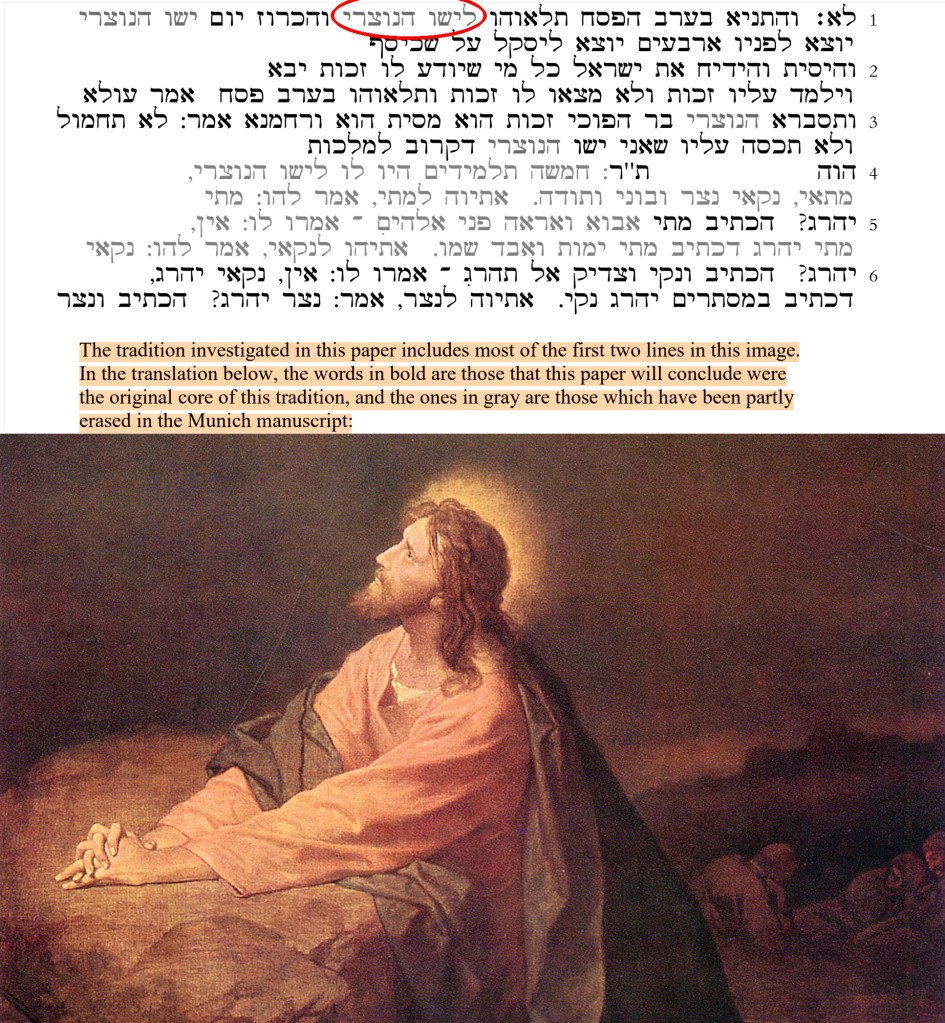
Now we come to the huge question raised by the confirmation that “ha-Nootz(e/a)ri” was one of the ancient and original appellations applied to Jesus – the one most of us are familiar with in the mistranslated form of “of Nazareth” – a question so far raised only by myself this Easter, strangely enough:
What in the world does the term Nootz(e/a)ri refer to and mean? Well, this question, and several related to it, was actually answered, insofar as it was possible to answer it at the time, some 150 years ago, by a person I have come to admire very much (quite possibly one of the most intelligent women of all time) – a lady who was herself an admirer of Christ (albeit not a “believer”), and whose collected works reveal that she was not at all like some detractors have made her out to be, and I will now quote a large portion of her answer verbatim (for the sake of context and completeness, I commence the quote a few sentences before the main unveiling begins; will your attention span allow you to digest it, dear reader, and will you be able to handle the truth?):
Quote: Otfried Muller shows how much the Orphic Mysteries differed from the popular rites of Bacchus, although the Orphikoi are known to have followed the worship of Bacchus. The system of the purest morality and of a severe asceticism promulgated in the teachings of Orpheus, and so strictly adhered to by his votaries, are incompatible with the lasciviousness and gross immorality of the popular rites.
The fable of Aristaeus pursuing Eurydike into the woods where a serpent occasions her death, is a very plain allegory, which was in part explained at the earliest times. Aristaeus is brutal power, pursuing Eurydike, the esoteric doctrine, into the woods where the serpent (emblem of every sun-god (…)) kills her; i.e., forces truth to become still more esoteric, and seek shelter in the Underworld, which is not the hell of our theologians.
Moreover, the fate of Orpheus, torn to pieces by the Bacchantes, is another allegory to show that the gross and popular rites are always more welcome than divine but simple truth, and proves the great difference that must have existed between the esoteric and the popular worship.
As the poems of both Orpheus and Musaeus were said to have been lost since the earliest ages, so that neither Plato nor Aristotle recognized anything authentic in the poems extant in their time, it is difficult to say with precision what constituted their peculiar rites. Still we have the oral tradition, and every inference to draw therefrom; and this tradition points to Orpheus as having brought his doctrines from India. As one whose religion was that of the oldest Magians – hence, that to which belonged the initiates of all countries, beginning with Moses, the “sons of the Prophets,” and the ascetic nazars (who must not be confounded with those against whom thundered Hosea and other prophets) to the Essenes.
*This latter sect were Pythagoreans* [!] before they rather degenerated, than became perfected in their system by the Buddhist missionaries, whom Pliny tells us established themselves on the shores of the Dead Sea, ages before his time, “per saeculorum millia.”
But if, on the one hand, these Buddhist monks were the first to establish monastic communities and inculcate the strict observance of dogmatic conventual rule, on the other they were also the first to enforce and popularize those stern virtues so exemplified by Sakya-muni, and which were previously exercised only in isolated cases of well-known philosophers and their followers; virtues preached two or three centuries later by Jesus, practiced by a few Christian ascetics, and gradually abandoned, and even entirely forgotten by the Christian Church.
The initiated nazars had ever held to this rule, which had to be followed before them by the adepts of every age; and the disciples of John were but a dissenting branch of the Essenes.
Therefore, we cannot well confound them with all the nazars spoken of in the Old Testament, and who are accused by Hosea with having separated or consecrated themselves to Bosheth; which implied the greatest possible abomination.
To infer, as some critics and theologians do, that it means to separate one’s self to chastity or continence, is either to advisedly pervert the true meaning, or to be totally ignorant of the Hebrew language. The eleventh verse of the first chapter of Micah half explains the word in its veiled translation: “Pass ye away, thou inhabitant of Saphir, etc.,” and in the original text the word is Bosheth. Certainly neither Baal, nor Iahoh Kadosh, with his Kadeshim, was a god of ascetic virtue, albeit the Septuaginta terms them, as well as the galli – the perfected priests – τετελεσμενους, the initiated and the consecrated.
The great Sod of the Kadeshim, translated in Psalm lxxxix. 7, by “assembly of the saints,” was anything but a mystery of the “sanctified” in the sense given to the latter word by Webster. The Nazireate sect existed long before the laws of Moses, and originated among people most inimical to the “chosen” ones of Israel, viz., the people of Galilee, the ancient olla-podrida of idolatrous nations, where was built Nazara, the present Nazareth.
It is in Nazara that the ancient Nazoria or Nazireates held their “Mysteries of Life” or “assemblies,” as the word now stands in the translation, which were but the secret mysteries of initiation, utterly distinct in their practical form from the popular Mysteries which were held at Byblus in honor of Adonis.
While the true initiates of the ostracised Galilee were worshipping the true God and enjoying transcendent visions, what were the “chosen” ones about?
Ezekiel tells it to us (chap. viii) when, in describing what he saw, he says that the form of a hand took him by a lock of his head and transported him from Chaldea unto Jerusalem. “And there stood seventy men of the senators of the house of Israel. . . . ‘Son of man, hast thou seen what the ancients . . . do in the dark?’” inquires the “Lord.” “At the door of the house of the Lord . . . behold there sat women weeping for Tammuz” (Adonis). We really cannot suppose that the Pagans have ever surpassed the “chosen” people in certain shameful abominations of which their own prophets accuse them so profusely. To admit this truth, one hardly needs even to be a Hebrew scholar; let him read the Bible in English and meditate over the language of the “holy” prophets.
This accounts for the hatred of the later Nazarenes for the orthodox Jews – followers of the exoteric Mosaic Law – who are ever taunted by this sect with being the worshippers of Iurbo-Adunai, or Lord Bacchus.
Passing under the disguise of Adoni-Iachoh (original text, Isaiah lxi. 1), Iahoh and Lord Sabaoth, the Baal-Adonis, or Bacchus, worshipped in the groves and public sods or Mysteries, under the polishing hand of Ezra becomes finally the later-vowelled Adonai of the Massorah – the One and Supreme God of the Christians!
“Thou shalt not worship the Sun who is named Adunai,” says the Codex of the Nazarenes; “whose name is also Kadush and El-El. This Adunai will elect to himself a nation and congregate in crowds (his worship will be exoteric) . . . Jerusalem will become the refuge and city of the Abortive, who shall perfect themselves (circumcise) with a sword . . . and shall adore Adunai.”
The oldest Nazarenes, who were the descendants of the Scripture nazars, and whose last prominent leader was John the Baptist, although never very orthodox in the sight of the scribes and Pharisees of Jerusalem were, nevertheless, respected and left unmolested. Even Herod “feared the multitude” because they regarded John as a prophet (Matthew xiv. 5). But the followers of Jesus evidently adhered to a sect which became a still more exasperating thorn in their side.
It appeared as a heresy within another heresy; for while the nazars of the olden times, the “Sons of the Prophets,” were Chaldean kabalists, the adepts of the new dissenting sect showed themselves reformers and innovators from the first.
The great similitude traced by some critics between the rites and observances of the earliest Christians and those of the Essenes may be accounted for without the slightest difficulty. The Essenes, as we remarked just now, were the converts of Buddhist missionaries who had overrun Egypt, Greece, and even Judea at one time, since the reign of Asoka the zealous propagandist; and while it is evidently to the Essenes that belongs the honor of having had the Nazarene reformer, Jesus, as a pupil, still the latter is found disagreeing with his early teachers on several questions of formal observance. He cannot strictly be called an Essene, for reasons which we will indicate further on, neither was he a nazar, or Nazaria of the older sect.
*What Jesus was, may be found in the Codex Nazaraeus*, in the unjust accusations of the Bardesanian Gnostics. “Jesu is Nebu, the false Messiah, the destroyer of the old orthodox religion,” says the Codex. He is the founder of the sect of the new nazars, and, as the words clearly imply, a follower of the Buddhist doctrine. In Hebrew the word naba means to speak of inspiration; and nebo is, a god of wisdom. But Nebo is also Mercury, and Mercury is Buddha in the Hindu monogram of planets. Moreover, we find the Talmudists holding that Jesus was inspired by the genius of Mercury. The Nazarene reformer had undoubtedly belonged to one of these sects; though, perhaps, it would be next to impossible to decide absolutely which.
But what is self-evident is that he preached the philosophy of Buddha-Sakyamuni. Denounced by the later prophets, cursed by the Sanhedrim, the nazars – they were confounded with others of that name “who separated themselves unto that shame,” they were secretly, if not openly persecuted by the orthodox synagogue.
It becomes clear why Jesus was treated with such contempt from the first, and deprecatingly called “the Galilean.”
Nathaniel inquires – “Can there any good thing come out of Nazareth?” (John i. 46) at the very beginning of his career; and merely because he knows him to be a nazar. Does not this clearly hint, that even the older nazars were not really Hebrew religionists, but rather a class of Chaldean theurgists?
*Besides, as the New Testament is noted for its mistranslations and transparent falsifications of texts, we may justly suspect that the word Nazareth was substituted for that of nasaria, or nozari.*
That it originally read “Can any good thing come from a nozari, or Nazarene”; a follower of St. John the Baptist, with whom we see him associating from his first appearance on the stage of action, after having been lost sight of for a period of nearly twenty years.
The blunders of the Old Testament are as nothing to those of the gospels. Nothing shows better than these self-evident contradictions the system of pious fraud upon which the super-structure of the Messiah-ship rests. “This is Elias which was for to come,” says Matthew of John the Baptist, thus forcing an ancient kabalistic tradition into the frame of evidence (xi. 14). But when addressing the Baptist himself, they ask him (John i. 21), “Art thou Elias?” “And he saith I am not”!
Which knew best – John or his biographer?
And which is divine revelation? The motive of Jesus was evidently like that of Gautama-Buddha, to benefit humanity at large by producing a religious reform which should give it a religion of pure ethics; the true knowledge of God and nature having remained until then solely in the hands of the esoteric sects, and their adepts.
As Jesus used oil and the Essenes never used aught but pure water, he cannot be called a strict Essene. On the other hand, the Essenes were also “set apart”; they were healers (assaya) and dwelt in the desert as all ascetics did. But although he did not abstain from wine he could have remained a Nazarene all the same. For in chapter vi. of Numbers, we see that after the priest has waved a part of the hair of a Nazorite for a wave-offering before the Lord, “after that a Nazarene may drink wine” (v. 20).
The bitter denunciation by the reformer of the people who would be satisfied with nothing is worded in the following exclamation: “John came neither eating nor drinking and they say: ‘He hath a devil.’ . . . The Son of Man came eating and drinking, and they say: ‘Behold a man gluttonous and a wine-bibber.’”
And yet he was an Essene and Nazarene, for we not only find him sending a message to Herod, to say that he was one of those who cast out demons, and who performed cures, but actually calling himself a prophet and declaring himself equal to the other prophets.
The author of Sod shows Matthew trying to connect the appellation of Nazarene with a prophecy, and inquires “Why then does Matthew state that the prophet said he should be called Nazaria?” Simply “because he belonged to that sect, and a prophecy would confirm his claims to the Messiah-ship. . . . Now it does not appear that the prophets anywhere state that the Messiah will be called a Nazarene.” The fact alone that Matthew tries in the last verse of chapter ii. to strengthen his claim that Jesus dwelt in Nazareth merely to fulfil a prophecy, does more than weaken the argument, it upsets it entirely; for the first two chapters have sufficiently been proved later forgeries.
Baptism is one of the oldest rites and was practiced by all the nations in their Mysteries, as sacred ablutions. Dunlap seems to derive the name of the nazars from nazah, sprinkling; Bahak-Zivo is the genius who called the world into existence out of the “dark water,” say the Nazarenes; and Richardson’s Persian, Arabic, and English Lexicon asserts that the word Bahak means “raining.”
But the Bahak-Zivo of the Nazarenes cannot be traced so easily to Bacchus, who “was the rain-god,” for the nazars were the greatest opponents of Bacchus-worship.
“Bacchus is brought up by the Hyades, the rain-nymphs,” says Preller; who shows, furthermore, that at the conclusion of the religious Mysteries, the priests baptized (washed) their monuments and anointed them with oil.
All this is but a very indirect proof. The Jordan baptism need not be shown a substitution for the exoteric Bacchic rites and the libations in honor of Adonis or Adoni – whom the Nazarenes abhorred – in order to prove it to have been a sect sprung from the “Mysteries” of the “Secret Doctrine”; and their rites can by no means be confounded with those of the Pagan populace, who had simply fallen into the idolatrous and unreasoning faith of all plebeian multitudes.
John was the prophet of these Nazarenes, and in Galilee he was termed “the Saviour,” but he was not the founder of that sect which derived its tradition from the remotest Chaldeo-Akkadian theurgy.
“The early plebeian Israelites were Canaanites and Phoenicians, with the same worship of the Phallic gods – Bacchus, Baal or Adon, Iacchos – Iao or Jehovah”; but even among them there had always been a class of initiated adepts.
Later, the character of this plebe was modified by Assyrian conquests; and, finally, the Persian colonizations superimposed the Pharisean and Eastern ideas and usages, from which the Old Testament and the Mosaic institutes were derived.
The Asmonean priest-kings promulgated the canon of the Old Testament in contradistinction to the Apocrypha or Secret Books of the Alexandrian Jews – kabalists. Till John Hyrcanus they were Asideans (Chasidim) and Pharisees (Parsees), but then they became Sadducees or Zadokites – asserters of sacerdotal rule as contradistinguished from rabbinical. The Pharisees were lenient and intellectual, the Sadducees, bigoted and cruel.
(…)
Verily the disciples who wrote the Codex Nazaraeus were right. Only it is not Jesus himself, but those who came after him, and who concocted the Bible to suit themselves, that “perverted John’s doctrine, changed the baptism of the Jordan, and perverted the sayings of justice.” It is useless to object that the present Codex was written centuries after the direct apostles of John preached. So were our Gospels. When this astounding interview of Paul with the “Baptists” took place, Bardesanes had not yet appeared among them, and the sect was not considered a “heresy.”
(…)
But we may offer another question: If baptism is the sign of regeneration, and an ordinance instituted by Jesus, why do not Christians now baptize as Jesus is here represented as doing, “with the Holy Ghost and with fire,” instead of following the custom of the Nazarenes?
In making these palpable interpolations, what possible motive could Irenaeus have had except to cause people to believe that the appellation of Nazarene, which Jesus bore, came only from his father’s residence at Nazareth, and not from his affiliation with the sect of Nazaria, the healers?
To assure ourselves that Jesus was a true Nazarene – albeit with ideas of a new reform – we must not search for the proof in the translated Gospels, but in such original versions as are accessible. Tischendorf, in his translation from the Greek of Luke iv. 34, has it “Iesou Nazarene”; and in the Syriac it reads “Iasoua, thou Nazaria.”
Thus, if we take in account all that is puzzling and incomprehensible in the four Gospels, revised and corrected as they now stand, we shall easily see for ourselves that the true, original Christianity, such as was preached by Jesus, is to be found only in the so-called Syrian heresies. Only from them can we extract any clear notions about what was primitive Christianity.
Such was the faith of Paul, when Tertullus the orator accused the apostle before the governor Felix. What he complained of was that they had found “that man a mover of sedition . . . a ringleader of the sect of the Nazarenes”; and, while Paul denies every other accusation, he confesses that “after the way which they call heresy, so worship I the God of my fathers.”
This confession is a whole revelation. It shows: 1, that Paul admitted belonging to the sect of the Nazarenes; 2, that he worshipped the God of his fathers, not the trinitarian Christian God, of whom he knows nothing, and who was not invented until after his death; and, 3, that this unlucky confession satisfactorily explains why the treatise, Acts of the Apostles, together with John’s Revelation, which at one period was utterly rejected, were kept out of the canon of the New Testament for such a length of time.
End of quote. Have you guessed who the extremely knowledgeable author is?
I do not necessarily endorse all of that which is said here, by the way, but I would estimate that about seventy or eighty percent of it is fairly accurate. I have not read the Codex myself.
(Blavatsky, 2019, pp. 1074–1085)
Blavatsky, Helena. (2019). The Secrets of Spirituality & (the) Occult [Kindle Edition]. Musaicum Books
Illustrations (Wikimedia Commons):
Screenshot of Dr. Instone-Brewer’s digitized version of the “deleted” passage in the Talmud where the trial and the execution of “Yeshu ha-Notzri” are spoken of. With a section of the painting “Christ in the Garden of Gethsemane”, by Heinrich Johann Hofmann.
“The Way to Emmaus” (1877), by Robert Zünd (1827–1909)
This post was originally published on my profile at Academia.edu in April 2025, during Easter. It got 241 views, and received six likes. Five comments were made on it.
 Edmund Schilvold: Skribent, fotograf, filosof, friluftsentusiast
2 kommentarer Legg til din