Today is December 21, a highly significant date here in Scandinavia and in other places in the world far to the north. The reason is, of course, that this is the date of the Winter Solstice, or of “Vinter-sol-verv”, as it is called in Norwegian, and of all the ancient traditions and celebrations associated with it. I have not attempted to look up the etymology of the English term, but the Norwegian one is usually thought of as meaning “the turning of the Sun”, i.e. the time when, after roughly six months of gradually shortening days, and a few days of virtual stasis, during which the solar year is at its darkest, and existence here in Northern Europe is also at its gloomiest – and often not only in a practical and naturalistic sense, but also in a psychological and spiritual one – the Sun is seen as “turning”, or as having completed its “(k)verv” or “circle”, and when it once again, having overcome (or being just about to overcome) the darkness of winter, closely associated with death, slowly but surely begins to reassert itself – at first almost imperceptibly, but then with ever-increasing power.
Here in Scandinavia, and in the rest of Northern Europe, this day, and the days surrounding the Winter Solstice, has been imbued with great importance since time immemorial, not only because this reawakening – one could almost say resurrection or (re)birth – of the Sun was a matter of life and death, of survival, in a practical sense, which, before the modern view of Nature, with its faith in unfailing causation, was not taken entirely for granted, but because this was a mental and religious watershed moment; the long-sought-after “turning point” in the great, ever-recurring cosmic battle between Light and Darkness, Order and Disorder, Truth and Falsehood, Justice and Injustice – the milestone moment when the Sun, who is also the Son – the metaphorical Son of the First Cause – finally overcame the power or powers of chaos and obscurity, and commenced the routing of its perennial enemies.
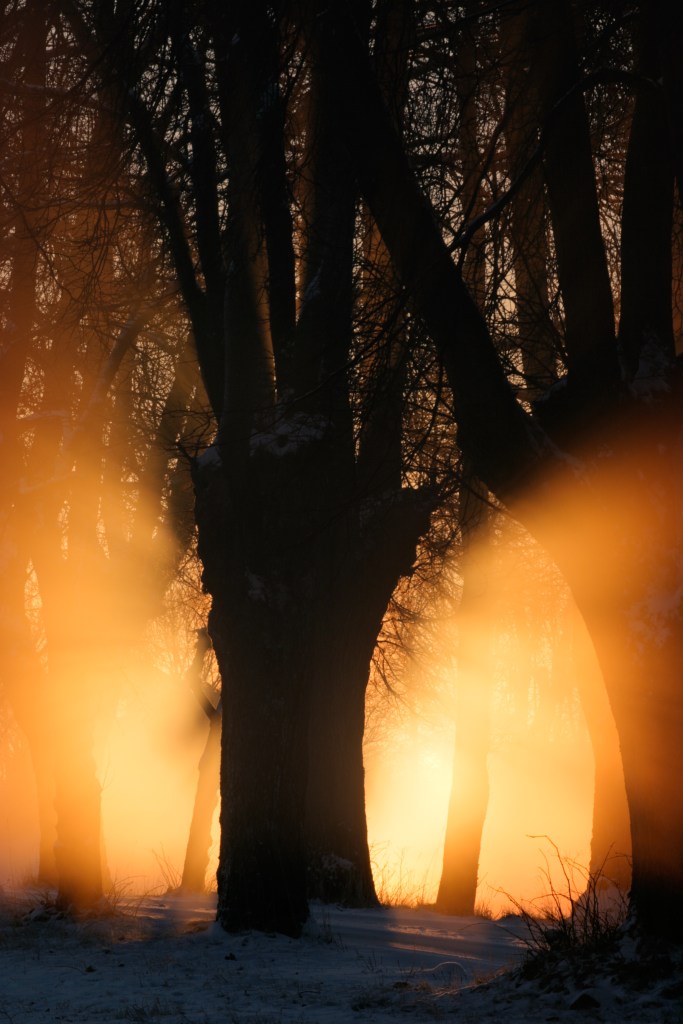
The Winter Solstice is, in other words, not simply a time of practical interest, but a Time of Victory – the Victory of Good over Evil, or, as a Platonist would put it, of Knowledge over Ignorance, and it is a victory that is, or seems, certain – as certain as the expectation, which is really only an assumption, that the season of spring eventually will come again.
That is why the ancient Romans celebrated Sol, or the Sun, as Invictus, i.e. as invincible or unconquerable, in the month of December. The (Re-)Birth and the Resurrection of the Sun is, regardless of whether the story of the life of IESOUS is true in a literal–historical sense or not, as real and true in the metaphorical, allegorical, metaphysical and moral senses as a scientific fact is empirically.
In the minds of people where the darkness of December is less pronounced than in Northern Europe and other such regions, statements like these may not evoke much in the way of feelings and associations, and the same may be true of people reduced to a purely profane and materialistic mindset, but to those of us who are not only inhabiting the regions near the tilted axis of our Earth but who are also in touch with Nature and ourselves, the seeming decent of the Sun into Hades, and its resurgence in the wake of its “turning”, is as important and tangible and loaded with feeling as the similar cycle of Day and Night was to the ancient Egyptians, who invested the hours from one sunrise to the next with as much spiritual significance as the ancient Northmen read into the annual solar cycle.
But both the Northmen and the Egyptians probably perceived with what marvellous simplicity and symmetry the smaller solar cycles, those easily perceptible to a human being, are mirrored, as it were, in the far greater cycle of one “Year of Ages”, one Maha-Yuga, or one Great Age, one Age of Ages, consisting of the four lesser ages held as real by virtually all the ancients, in spite of differing beliefs regarding the details; the Golden, the Silver, the Bronze and the Iron, commencing with the Return of the Divine King, so to speak, an incarnation or avatar of God, or rather of the Spiritual Sun, the great “Messiah” who, in one glorious and liberating Sunrise, vanquishes all Evil and inaugurates a new Golden Age, an age of Truth and Piety, Harmony and Justice, which inevitably, like the First or Highest Government of Plato, slowly but surely degenerates into its successors, so that, eventually, the terrible depths of the final lesser age, the Age of Iron, or the Kali Yuga, or the End Times, are reached – depths comparable to those of midwinter and midnight, when the Light is almost wholly extinguished, strange and unfamiliar beings rear their unsettling heads, and even the best of eyes are rendered almost impotent, and the clarity of ordinary sight is temporarily lost.
The Vedic Indians perceive such a mirroring to this very day, of course, and boldly assert that one such Great Age consists of no less than 4,320,000 years. Yet even a Maha-Yuga is not the largest cycle, not in the Vedic/»Hindu» cosmological schema.
E.S.
This post was originally published on my profile at Academia.edu back in December 2024. It received 152 views and eight likes.
 Edmund Schilvold: Skribent, fotograf, filosof, friluftsentusiast