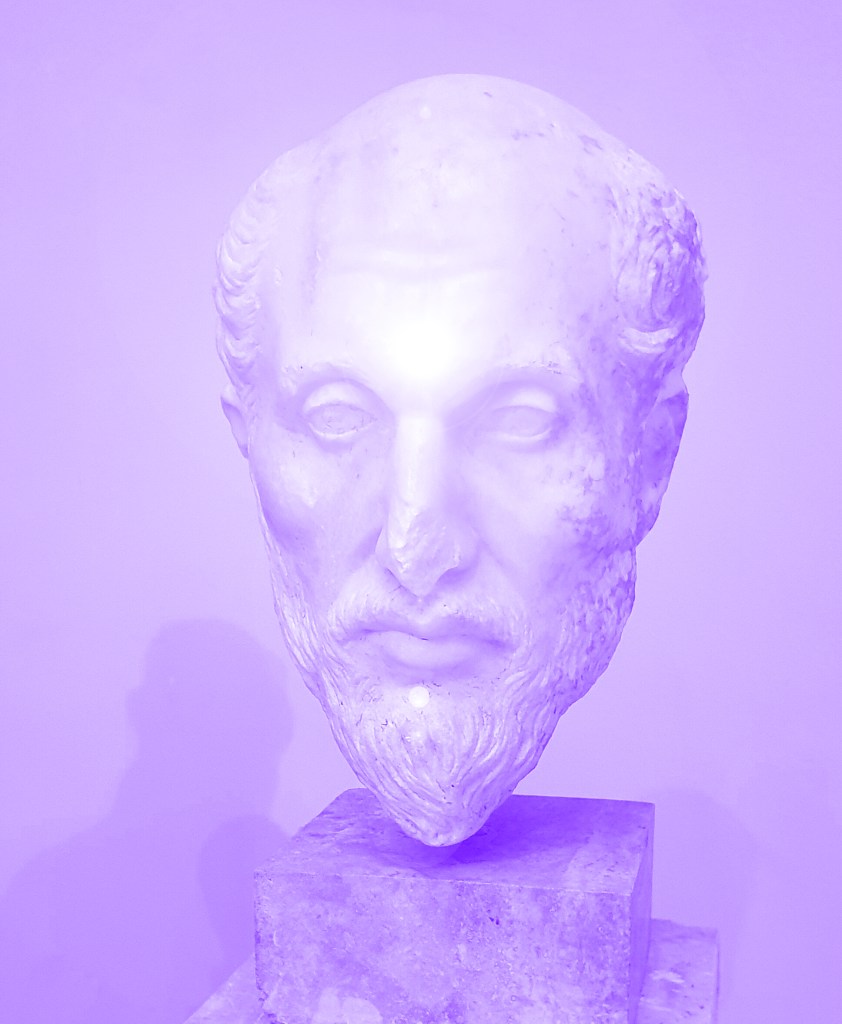
Have you ever read Porphyry’s beautiful tribute to his Master and Guru, the wonderful Plotinus; the Platonic Philosopher-Mystic of whom the famous ancient literary critic Longinus admiringly said «set the principles of Pythagoras and of Plato in a clearer light than anyone before him» (and who may have been a close friend of Origen)? You should; here is an excerpt for you:
«Good and kindly, singularly gentle and engaging: thus the oracle presents him, and so in fact we found him. Sleeplessly alert – Apollo tells – pure of soul, ever striving towards the Divine which he loved with all his being, he laboured strenuously to free himself and rise above the bitter waves of this blood-drenched life:
and this is why to Plotinus – god-like and lifting himself often, by the ways of meditation and by the methods Plato teaches in the Banquet [the Symposium; the dialogue], to the first and all-transcendent God – that God appeared, the God who has neither shape nor form but sits enthroned [so to speak] above the Intellectual Principle and the entire Intellectual [Noetic] Sphere.
‘There was shown to Plotinus the End ever near’: for the End, the One End, of his life was to become Whole, to approach to the God over all: and four times, during the period I passed with him, he achieved this End, by no mere latent fitness but by the ineffable Act.
To this God, I also declare, I Porphyry, that in my sixty-eighth year I too was once admitted and I entered into Union.
We are told that often when he was leaving the way, the gods set him on the true path again, pouring down before him a dense shaft of light; here we are to understand that in his writing he was overlooked and guided by the divine powers.
‘In this sleepless vision [a term used by Plato, in his «Republic»] within and without,’ the oracle says, ‘your eyes have beheld sights many and fair not vouchsafed to all that take the Philosophic Path’: contemplation in man may sometimes be more than human, but compare it with the True Knowing of the gods and, wonderful though it be, it can never plunge into the depths their Divine Vision fathoms.
This post was originally published on my profile at Academia.edu back in October 2024. It received 220 views and five likes.
 Edmund Schilvold: Skribent, fotograf, filosof, friluftsentusiast