As a historian – and I do consider myself one – I tend to look for two distinct features in the data I peruse: Patterns and limits. Both of these excite my interest like few other topics, and both of these may only be adequately identified and gauged and ascertained once vast amounts of data, usually of the written or archaeological kinds, have been imbibed and processed and mulled over.
That could be why relatively contemporary academics seem to deal with them, even though they must be said to be of supreme importance, for such investigative work quickly consumes enormous amounts of time, in spite of the fact that I usually find that ordinary, linear time never seems less relevant and more non-existent than when my attention is wholly focused on a different day and age.
You may wonder what I mean by limits and patterns. When it comes to limits, I search for and contemplate the limits of recorded history in much the same way as I searched for and contemplated the limits of this known universe decades ago, when I was still a teenager, and was fascinated by popular science and astronomy. I was not a scientist back then, of course, but I was in possession of the Introverted Intuition, as Carl Gustav Jung styled it, which I am still exercising now, and in a manner similar to how I then marvelled in amazement at the alleged beginning of this Cosmos of ours, a beginning which seemed to be traceable to a single, miniscule point, a point emerging out of the Wholly Unknown, and also to how the wonderful Adornment that is the World (Cosmos means adornment in Greek) would appear to have its allotted time of explosive expansion – a mysterious expansion into a Something of a nature unknown, it would seem – at the end of which the entire Creation is doomed to either die to slow death of Dissipation or to violently contract into the state it was in before it all began;
in a manner similar to that, I say, I now pursue the distant limits of recorded human history, while simultaneously wondering how our story might eventually come to an end – will it come as a long and painful, irreversible process of decay, a slow petering out of all that is noble and worthwhile into the doom of the bottomless abyss, or as a Big Bang in reverse; a vast, sudden implosion of it all into a tiny point, which, after a moment of absolute silence and absolute absence of light, violently kindles the fire of a new and glorious Genesis; the Genesis of a New Age or Yuga?
It is as part of this ongoing quest for the Limits of Human Existence that I have, somewhat reluctantly, been brought to the suspicion that the surprising convergence of two sets of data, one ancient and one of very recent origin (the last twenty years or so), finally enables us to extend the frontier of recorded human history to a greater date then ever before since the present situation began, namely to the period of c. 12,900 to c. 11,600 years ago, or, in other words, to a period roughly twice as far removed from us in time as those historians have been treating of since the great era of European archaeological excavations and discoveries began, in the early 1800s.
This new frontier period is the astonishingly cataclysmic period in the history of our planet which geologists have styled the Younger Dryas (YD), and during which the climate of our Earth underwent a series of almost unimaginably dramatic convulsions, the scale of which have never been seen since, and which may be said to mark the final end of the most recent cold period in the greater Quaternary Ice Age we are still in (and which we have been in for more than two and a half million years), and the commencement of the comparatively balmy Holocene. (Yes, that is correct – we are in fact still in a greater ice age, and before the Quaternary, the climate was far warmer than it was in even the warmest periods of the present Holocene.)
Incredibly, new and very solid scientific evidence, which only began emerging in full after the beginning of this new millennium, and which has barely been referred to in mainstream media and pop culture thus far, makes the conclusion that these epic convulsions were caused by impacts from outer space well nigh inescapable.
As I understand the matter, it seems safe to say that large meteors hit our planet c. 12,900 years ago, some crashing into the vast ice sheets then still covering much of what is now North America (such as the Laurentide Ice Sheet), and thereby unleashing, shortly thereafter, floods of truly “biblical” proportions. These were floods which would make even the sudden bursting of the Hoover Dam in the U.S., for example, pale by comparison, and which led to not only the carving out of the huge, “oversized” river valleys and canyons still visible in much of North America in a matter of hours or days, but to a sudden, global rise in sea levels.
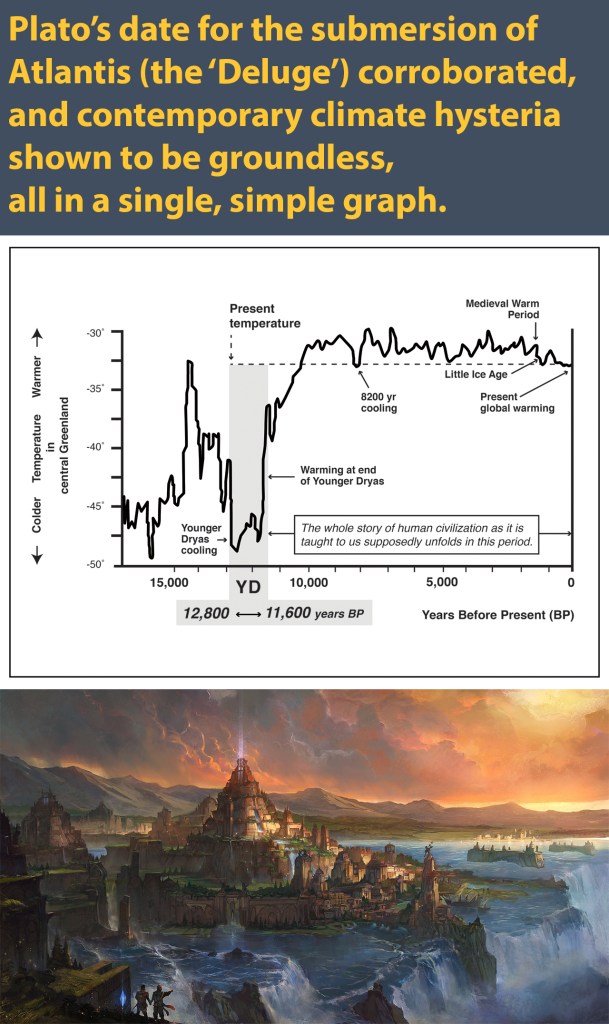
The American Randall Carlson has spoken about this at some length, and there is no need to reiterate here what he has already set forth in several excellent online presentations, but what neither his lectures, nor the similar ones by the Englishman Graham Hancock, have gone very deeply into, is how the date or time frame assigned by geologists like Firestone to the end of the Younger Dryas, c. 11,600 years ago, matches the date given to us by none other than Plato, in his seminal dialogue the Timaeus – where Plato refers to information handed down to him from Solon, the Great Lawgiver of Athens, who obtained it while visiting Egypt and conversing with Egyptian priests – for the destruction and submersion of the Island of Atlantis, and how this unexpected convergence of the historical data Plato claims to be providing in his Timaeus, as well as in his other dialogues dealing with Atlantis, with the now thoroughly corroborated science on the Younger Dryas and its “impact events”, forces a radical re-evaluation of the prevailing assessment of late modern academics as regards Plato’s Atlantis, or would force such a re-evaluation if more academics were more open-minded, and less set in their ways, since that assessment has, ever since the rise to prominence of that peculiarly late modern cynicism and cognitive fragmentation we are now so mired in, been that Plato’s Atlantis is more or less pure fiction, concocted for narrowly political purposes, and perhaps fiction of a rather “dangerous” kind, since – o, the shock and the horror – “the Atlantis psychosis” was in vogue during that time of rampant top-hat-sporting, authoritarian personalities, hurtful repression of crazy sexual fantasies and strident colonialism raping a picture-perfect, kumbaya world of noble savages and gallant cannibals that Boasian anthropologists and Marxian dogmatists love imagining was the essence of the Victorian and Edwardian eras.
Maybe such broad and rather brownish brushstrokes are actually the delusional projections of highly conditioned and indoctrinated modern brains, who, in their vain desire to say something of consequence, and to conform to the herd, see connections where there really are none, or only few and feeble ones, and who therefore end up short-circuiting, even while exclaiming “Eureka”, in ways which will hopefully be pitied and heartily laughed at by distant future generations, wiser and less brain-washed than those of our late modern age.
It is the sort of unthinking, ludicrously simplistic pseudo-thinking and malicious, ideologically motivated defamation which bursts out in pronouncements like “Plato was the first totalitarian”. Or maybe that distinction ought to go to Jesus Christ, if he ever existed, since the Christ of the Gospels clearly favors Divine Kingship over Democracy? Or the Buddha, since German researchers once visited Tibet to study not only snowy mountain peaks, but indigenous scull shapes? Perfect Aristotelian Logic, right? (Thank God Tibet was “liberated” by Mao’s henchmen not very long thereafter – and the “benevolent” Maoist communists, ever desiring only the best for all of human kind (as they claim), have only murdered, directly and indirectly, about six million “thankful” Tibetans. At least they got to behold the World Revolution in progress before their heads were smashed, or before their well-fed bourgeois bodies were starved to death. I am being sarcastic, of course.)
In all seriousness, though, such manipulated and manipulative thinking, in which anything whatsoever can and might be merged with anything else, for the sake of scoring easy Social Credit points, or with the aim of tarnishing a given object for subversive purposes, is becoming more and more rampant, it seems – not that the discourse of the past was always pretty, but such as was admitted as academic a hundred or two hundred years ago certainly tended to be more sober and impartial than the debates of today – and such thinking presents a very real menace, as opposed to its own, largely imaginary dangers, to the future of academia, of research and of science. It is a menace which carries in its bosom the reduction of the complexity of real life and of real history to caricature, the diversion of the greater purpose of academic life away from the lofty ideal of ever-increasing insight into universal truth, guided by the self-less goal of disinterested inquiry, and towards narrowly ideological battles and the most shameless lying by omission, and the effect of which will be, if such darkness wins the day, that the actor with the most powerful propaganda megaphone prevails.
But I digress. A second aspect of the almost revelatory convergence of ancient and modern data, of information in Plato’s ancient writings and the analyses of modern geology, outlined above, is how the now fairly probable piece of real history which gave rise to Plato’s descriptions of Atlantis may, and in my view should, compel future historians and theologians to carry out a radical re-evaluation of the origins, the nature and the purposes of the Book of Genesis in general, and of the Garden of Eden and Deluge narratives in particular.
To put it bluntly: Much of Genesis is likely a somewhat distorted, compressed and carefully crafted version of the story of Atlantis.
Ever thought of that one before?
Once you compare what Plato says of Atlantis and its fate to what the Book of Genesis says of the Garden of Eden and of Noah and the Flood, with an open mind, the kinship between the two sets of data becomes obvious, and rather difficult to ignore, and once these findings are seen in conjunction with what now largely forgotten ancient historians like Berossus and Sancuniathon the Phoenician and the early medieval monk Cosmas Indicopleustes say of the same topics, the inference that parts of Genesis are modelled, albeit in a cleverly veiled and highly sophisticated way, on the demise of the Atlantean civilization, becomes exceedingly difficult to avoid making.
And yes, the authors of Genesis, whoever they were, ingeniously altered the dates and compressed their novel narrative, so that the “world” was made to begin only a few millennia ago, and so that the catastrophes of the Younger Dryas, which were faintly or not so faintly remembered by peoples and civilizations all around the world as a Great Flood, was made to take place even more recently, and the whole literary creation was made to conform to the number 4320, which is a highly significant number in both the Mesopotamian/Chaldean/Sumerian-Akkadian and the Vedic/Hindu tradition.
Kings or Patriarchs living for exceptionally long periods of time? That is a Mesopotamian (Sumerian) and Egyptian idea, predating Genesis by millennia.
Four ages or stages of the world, the first being a Paradise-like one, of no worries, and the last being a dark and troublesome and impious one? That is a Vedic idea, also much older than Genesis. And at the end of the Dark Age or the End Times, the Divine Avatar or Savior appears, to wipe out all the Evil, and to institute a new Paradise or Golden Age.
Are we beginning to get it?
One of the bits of data we may recover by combining passages from the above mentioned writers is that the Survivor of the Flood, known to many of us as Noah, but called by various other names in the past, was warned by the planetary god Saturn or Chronos, better known today as YHWH or Yahoo(ah), to evacuate his land due to an impending disaster, and that this Flood Survivor actually left Atlantis, and wound up somewhere in what is now the Middle East.
We may also conclude that the stretch of “linear time” allegedly espoused by the Bible or the Torah is simply a truncated and compressed version of the stretch of time held by all the ancient cultures to be that going from the dawn of and to the extinction of one lesser time cycle (or yuga), via the ubiquitous four ages, and that the much-touted “linear” conception of time attributed to the Abrahamic religions is not actually linear at all, but is merely the result of the omission of the greater, cyclical context (still found in Vedic Indian literature).
The numerous mentions and allusions in both the Torah and the NT to the nature of the ancient cycle, and to the metals by which they were symbolized, make this entirely plain to the informed and open-minded reader.
To be continued
Younger Dryas Impact Event Bibliography
Firestone, R. B., West, A., Kennett, J. P., Becker, L., Bunch, T. E., Revay, Z. S., Schultz, P. H., Belgya, T., Kennett, D. J., Erlandson, J. M., Dickenson, O. J., Goodyear, A. C., Harris, R. S., Howard, G. A., Kloosterman, J. B., Lechler, P., Mayewski, P. A., Montgomery, J., Poreda, R., Darrah, T., Que Hee, S. S., Smith, A. R., Stich, A., Topping, W., Wittke, J. H., and Wolbach, W. S. (2007). Evidence for an extraterrestrial impact 12,900 years ago that contributed to the megafaunal extinctions and the Younger Dryas cooling. Proceedings of the National Academy of Science of the United States of America, 104(41). Retrieved from https://doi.org/10.1073/pnas.0706977104
Kinzie, C. R., Que Hee, S. S., Stich, A., Tague, K. A., Mercer C., Razink J. J., Kennett D. J., DeCarli P. S., Bunch T. E., Wittke J. H., Israde-Alcántara I., Bischoff J. L., Goodyear A. C., Tankersley K. B., Kimbel D. R., Culleton, B. J., Erlandson, J. M., Stafford, T. W., Kloosterman, J. B., Moore, A. M. T., Firestone, R. B., Aura Tortosa, J. E., Jordá Pardo, J. F., West, A., Kennett, J. P., and Wolbach, W. S.. (2014). Nanodiamond-Rich Layer across Three Continents Consistent with Major Cosmic Impact at 12,800 Cal BP. The Journal of Geology, 122(5). Retrieved from https://doi.org/10.1086/677046
Wolbach, W. S., Joanne P. Ballard, Paul A. Mayewski, Victor Adedeji, Ted E. Bunch, Richard B. Firestone, Timothy A. French, George A. Howard, Isabel Israde-Alcántara, John R. Johnson, David Kimbel, Charles R. Kinzie, Andrei Kurbatov, Gunther Kletetschka, Malcolm A. LeCompte, William C. Mahaney, Adrian L. Melott, Abigail Maiorana-Boutilier, Siddhartha Mitra, Christopher R. Moore, William M. Napier, Jennifer Parlier, Kenneth B. Tankersley, Brian C. Thomas, James H. Wittke, Allen West, and James P. Kennett. (2018). Extraordinary Biomass-Burning Episode and Impact Winter Triggered by the Younger Dryas Cosmic Impact ∼12,800 Years Ago. The Journal of Geology, 126(2). Retrieved from https://doi.org/10.1086/695703
This post was originally published on my profile at Academia.edu back in October 2024. It received 245 views and three likes, and gave rise to an extensive discussion now comprising 23 comments.
 Edmund Schilvold: Skribent, fotograf, filosof, friluftsentusiast